• Link to LinkedIn
  • Link to Facebook
  • Call Us
NutriFusion
  • Applications
    • All Blends
    • Food
    • Beverages & Drinks
    • Nutraceuticals
    • Pet Nutrition
    • Custom Superfood
  • R&D
    • Research & Development
    • Vitamin Deficiency
  • Active Research
  • About
    • About NutriFusion®
    • Certifications
  • Contact
  • News
    • Press Center
  • Podcasts
  • Blog
  • Store
  • Click to open the search input field Click to open the search input field Search
  • Menu Menu

Archive for category: Beverages & Drinks

Innovative Premix Products for Infants to Grow By 2028

in Beverages & Drinks, Consumer Packaged Goods, Kid's Health

Reading Time: 3 minutes

New market research predicts increasing growth of nutritional food premixes for infants over the next ten years. With more parents wanting to feed their precious babies with only the best infant formula, companies have developed innovative nutritional premixes with nucleotides, organic ingredients, probiotics, and botanicals—aside from the usual ingredients like Vitamin D, DHA, ARA, and iron to name a few.

Infant formulas are food products that are intended to give the right nutrition to babies and infants. When it comes to infant nutrition, premixes play an essential role in formulas. Infant nutrition premixes are customized blends that are intended to improve the overall nutritional value of infant formula.

More Formula Consumption in Near Future

The trend of unique infant formula is growing in developed countries particularly in North America due to the increasing awareness associated with different blends of vitamins, minerals, amino acids, and other fortifications. In fact, North America shares a large regional market for nutritional premixes for infant formula, and it is forecasted that the value of the market will rise to $103 million by the end of 2028.

Powdered infant nutritional premixes are preferred because of their convenience compared to liquid infant mixes.  Aside from convenience, the contamination of powdered premixes is lesser compared with liquid premixes.

Which Ingredients Are Popular in Powdered Premixes for Infants?


There are different types of ingredients put into powdered nutritional premixes. But one of the most popular ingredients used is nucleotides. Nucleotides are added widely not only in infant nutrition but even in pharmaceutical nutrition industries.  Premixes containing amino acids such as threonine, lysine, and methionine to name a few are very popular as they are the primary amino acids needed by small children to grow well. Infant nutritional premixes are now becoming more functional as they are designed to help improve bone health, digestion, and immunity of infants.

Infant nutritional premixes are gaining traction and are now competing with the sports nutrition market as one of the industries that use nucleotides, vitamins, and other dietary supplements. Formula producers are looking for more natural premixes from fruits and vegetables to create more attractive packaging.

Key Players in The Market

The company Future Market Insights (FMI) released a report titled “Infant Nutritional Premix Market: Global Industry Analysis (2012-2017) and Opportunity Assessment (2018-2028)” which revealed that there are now a lot of critical players taking a bite of the infant nutritional premix niche. These include Plc, Glanbia, Royal DSM N.V., GmbH & Co, BASF, Watson-Inc., Hexagon Nutritional Pvt. Ltd., Farbest Brands, Vitablend, ADM company, and Jubilant Life Sciences to name a few.

The market for customized infant nutritional premix is becoming popular and is expected to get stronger as more and more people are looking for infant food products that contain more value than the usual conventional baby formula products.

Inspired by thefinancialconsulting.com
https://nutrifusion.com/wp-content/uploads/2022/05/NutriFusion-Logo-New-1030x251.png 0 0 NF Admin https://nutrifusion.com/wp-content/uploads/2022/05/NutriFusion-Logo-New-1030x251.png NF Admin2018-04-10 10:18:392018-04-10 10:18:39Innovative Premix Products for Infants to Grow By 2028

Scott Gottlieb’s FDA Will Continue to Push Food Transparency Measures

in Beverages & Drinks, Consumer Packaged Goods, Food Business, Food Retail, Health & Nutrition

Reading Time: 3 minutes

With the focus on deregulation by the Trump administration, many food industry experts worried that the newly appointed commissioner of the FDA, Scott Gottlieb, would roll back pending changes to nutrition labels and consumer information. However, at a recent conference, Gottlieb made it clear that the FDA is going to continue to push for food transparency with Nutrition Facts, labeling, and definitions playing a significant role in the agency’s new nutrition innovation strategy.

Improving the Health of Americans Through Food Transparency

At the National Food Policy Conference in Washington, D.C., Gottlieb let everyone know that the nutrition innovation strategy is meant to improve the health of all American regardless of socioeconomic status.

“Our challenge is to help create more healthful choices and foster inovation and competition, and also make these choices more afordable.” – Scott Gottlieb, FDA Commissioner

A study found that 20% of American deaths in 2015 could be attributed to poor dietary factors. Gottlieb made sure to emphasize the importance of research and facts on everything his agency does. He said that clear science-based information is the central pillar of the work we do at the FDA and is essential to helping drive better consumer choices.

Nutrition Facts Labeling Updates


Gottlieb indicated that the new Nutrition Facts labeling initiative is of the utmost importance, but he wants to make sure it is right. He wants to roll out the new label with a consumer educational campaign to help the average American better understand how many calories they should be consuming each day.

On top of the new label, he promised to handle the definition of “healthy” and “natural” for labeling. A core definition of “healthy” is critical to help consumers better understand what they are buying. The new definition will consider nutrient content. Consumers also want more clarity on “natural” which has never been defined by the NDA. While Gottlieb did not offer up much on this definition, he did indicate that it will need to be science-based.

Streamlining the Labeling Process for Food Manufacturers

Gottlieb believes the regulatory labeling process is currently too lengthy and time consuming for food manufacturers. He has added to his docked to streamline the labeling process to modern times. He wants it to be easy for consumers to understand the health benefits of a product.

He wants to make it easier for the food companies to clean up their labels. Interestingly, he used vitamins as an example since they typically appear by their chemical name on the ingredient statement. We believe it should stay this way as most of these vitamins do not come from whole food sources and are chemically derived. Our GrandFusion products concentrate these natural vitamins from fruits and vegetables and as a result, allow products to use a much cleaner ingredient statement.

Conclusion on Gottlieb’s Remarks

The FDA is overall in good hands with this Trump appointee. He is committed to pushing forward all of the Obama-era regulations and making decisions on scientific fact. He believes some of the processes in the FDA are archaic and need updating to work faster in today’s environment. It will be interesting to see all the changes that move forward under Scott Gottlieb’s leadership.

Inspired by www.fooddive.com

https://nutrifusion.com/wp-content/uploads/2016/11/shallow-depth-of-field-image-of-nutrition-facts-PPCFXVQ-min.jpg 1030 1545 NF Admin https://nutrifusion.com/wp-content/uploads/2022/05/NutriFusion-Logo-New-1030x251.png NF Admin2018-04-04 08:39:592018-04-04 08:39:59Scott Gottlieb’s FDA Will Continue to Push Food Transparency Measures

Starbucks is Working on Blockchain for “Bean to Cup” Tracking

in Beverages & Drinks, Food Business, Food Retail

Reading Time: 2 minutes

Starbucks released this week that it is working with blockchain technology to create a “bean to cup” tracking system. The innovation is driven by the consumer’s desire for more transparency into where food and beverages come from. Starbucks is launching the pilot program to track coffee beans from Costa Rica, Rwanda, and Colombia.

Starbucks + Blockchain = Coffee Traceability

The premium coffee company believes that blockchain’s “traceability technology” pairs well with their commitment to ethically sourced coffee and ecologic sustainability. Starbucks believes the technology will enable them to strengthen their supply chain and relationship with consumers.

The blockchain pilot program will go through multiple phases over the next two years. The pilot will fall in line with the Sustainable Coffee Challenge that the company championed with Conservation International in 2015. The company plans to share its results with the public.

Shortcomings of Current Blockchain Technology for the Food Supply Chain

The traceability of coffee beans to the cup is a noble cause by Starbucks, but it is worth noting that there are still some shortcomings with blockchain technology when applied in the food industry. Food supply chain experts still believe the “winning” blockchain application has yet to be developed for the food industry.

There are currently issues with entirely tracking that ingredient to the final product in many cases. IBM is working on a few innovations to help solve this issue. They believe that “cryptographic anchors” may be the solution in the next five years. Anchors would include microscopic, digestible ink dots on products to verify the authenticity of the final product within the supply chain.

While there are a few shortcomings, Starbucks is again leading the way with technology in the food industry. It will be interesting to see how blockchain works for them over the next few years.

Inspired by www.ciodive.com


https://nutrifusion.com/wp-content/uploads/2022/05/NutriFusion-Logo-New-1030x251.png 0 0 NF Admin https://nutrifusion.com/wp-content/uploads/2022/05/NutriFusion-Logo-New-1030x251.png NF Admin2018-03-23 08:22:482018-03-23 08:22:48Starbucks is Working on Blockchain for “Bean to Cup” Tracking

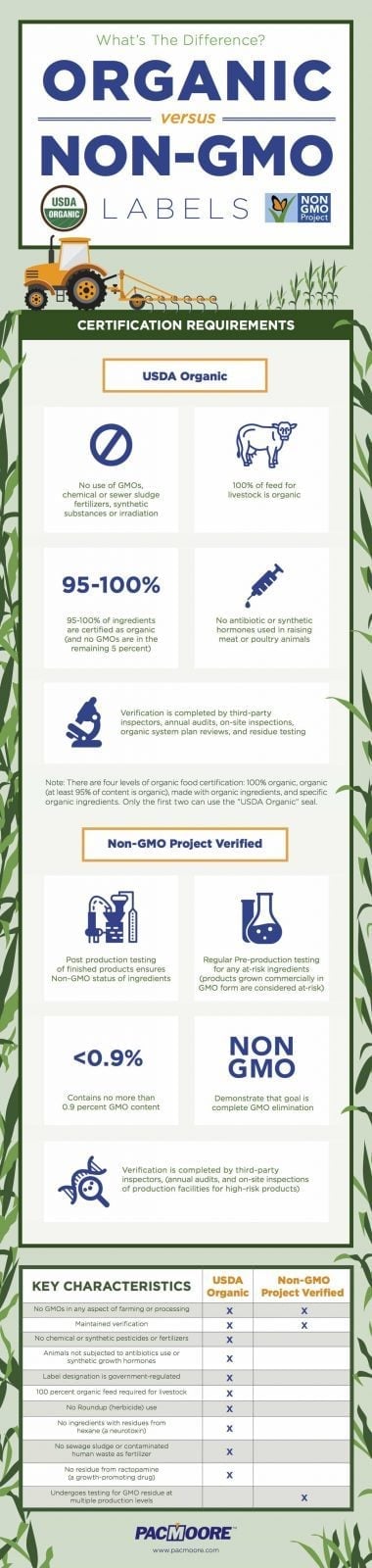
Infographic: Organic vs. Non-GMO – What’s the Difference?

in Beverages & Drinks, Consumer Packaged Goods, Food Business, Food Retail, Infographics, Supplements & Nutraceuticals

PacMoore recently released an interesting infographic on the differences between organic and non-GMO labels. Most consumers, as well as food brands, struggle to understand what is the difference. The certification and verification process is much different. Check out PacMoore’s infographic to learn more!

organic non-gmo what is difference certification verification

Inspired by https://www.pacmoore.com/organic-versus-non-gmo-labels/

https://nutrifusion.com/wp-content/uploads/2022/05/NutriFusion-Logo-New-1030x251.png 0 0 NF Admin https://nutrifusion.com/wp-content/uploads/2022/05/NutriFusion-Logo-New-1030x251.png NF Admin2018-03-07 08:46:382018-03-07 08:46:38Infographic: Organic vs. Non-GMO – What’s the Difference?

On-The-Go Habits Putting Pressure on Ingredient Manufacturers

in Beverages & Drinks, Consumer Packaged Goods, Food Business, Supplements & Nutraceuticals

Reading Time: 3 minutes

During the CAGNY conference in Florida, Food Dive sat down with ingredient manufacturer, Ingredion, to talk about insights into how CPG companies are planning for growth and adapting to changing consumer preferences. The CEO of Ingredion, Jim Zallie, believes that on-the-go consumption habits are the most challenging for the ingredient industry. The lucrative market opportunity is leading new players in the restaurant and retailer industry to compete with well-known CPG brands.

The Grab-and-Go is Stressing Ingredient Companies to Adapt

Jim Zallie told a consumer analyst group that the grab-and-go market, as well as food ordered online, has reached $110 billion globally. In just one year, from 2015 to 2016, the amount of U.S. on-the-go purchases grew by 56%. Zallie told the audience that this is critical to ingredient companies because of the importance of developing high-quality products that deliver the right texture and maintains heat.

Ingredion North American President, Jorgen Kokke says that texture claims on packaging have increased by over 90% in the past five years.

“We can talk about health trends… We can talk about cost and affordability and sustainability, but underneath all of that, [food] always has to taste good and be fun. And that’s where texture comes in. … We say it’s as important as flavor.”

Jorgen Kokke

Pockets of Growth in Functional On-The-Go Foods

Zallie believes there are “pockets of growth in the food anywhere space.” He points to the fresh refrigerated space as a critical example. The freshly prepared food category is generating over $25 billion in sales annually according to the Supermarket Guru. The clean label trend and simple ingredient trend play significant roles in the development of functional on-the-go foods. With 62% of consumers now looking for recognizable ingredients on the label, it’s imperative to use things they understand.

NutriFusion developed the GrandFusion product line for this very reason. We saw the way synthetic vitamins were reading on the label and thought there had to be a better way. With our products, consumers read fruits and vegetables instead of chemicals, so it makes a lot more sense to them. See the graphic below. If you are interested in learning more, visit our R&D page and download the GrandFusion resource kit to get started with product development.

supplements-ingredients-nutrition-panel-clean-label

https://nutrifusion.com/wp-content/uploads/2018/03/healthy-food-ingredients-P9LTHGD-min.jpg 1030 1486 NF Admin https://nutrifusion.com/wp-content/uploads/2022/05/NutriFusion-Logo-New-1030x251.png NF Admin2018-03-06 08:57:572018-03-06 08:57:57On-The-Go Habits Putting Pressure on Ingredient Manufacturers

New Survey Reveals Why Consumers Buy Plant-Based Dairy Alternatives

in Beverages & Drinks, Consumer Packaged Goods, Food Business, Food Retail, Supplements & Nutraceuticals

Reading Time: 2 minutes

Comax Flavors introduced survey last summer to better understand consumer perceptions around plant-based dairy alternatives. Comax surveyed 1,000 adults in the United States last July that said they used plant-based dairy products at least three days a week.

Why are Consumers Buying Plant-based Dairy Products?

This question about purchase behavior was at the center of Comax’s survey. They found that for most (48%) consumers, the flavor was the top reason why the purchased the plant-based alternatives. The most frustrating takeaway for the dairy industry was that 36% of consumers bought plant-based dairy products because of the perceived health benefits. Dairy industry veterans are annoyed because they believe that cow’s milk is nutritionally superior.


The survey also took a look at health and wellness as well as animal welfare to understand better why the rapid growth in plant-based dairy products. They found that the younger generations (millennials and Gen Z) were more concerned and influenced by animal welfare. As a result, they are purchasing more plant-based products all around.

The Plant-Based Category Continues to Soar, and Dairy Fights Back

Non-dairy milk sales have soared over 61% in the past five years to an estimated market size of $2.11 billion in 2017. In that same period, regular dairy milk sales have dropped by 15% to $16.12 billion in 2017.


The dairy industry is not going down without a fight and is pursuing a variety of options to challenge the new plant-based dairy alternatives. They are taking plant-based beverages to court over the word “milk” much like how Unilever challenged Just Mayo over the use of “Mayo” in the name. It will be interesting to see how this plays out.

The dairy industry is also trying to diversify with innovative products including carbonated or fizzy milk products. The new products have a longer shelf life than traditional milk which hits on one of the plant-based dairy’s competitive advantages.

Plant-based dairy products are not going anywhere anytime soon. It’s interesting to see why consumers are buying them and it turns out the flavor is the significant factor. The dairy industry will have their hands full trying to slow down this plant-based boom.

Inspired by www.fooddive.com

https://nutrifusion.com/wp-content/uploads/2022/05/NutriFusion-Logo-New-1030x251.png 0 0 NF Admin https://nutrifusion.com/wp-content/uploads/2022/05/NutriFusion-Logo-New-1030x251.png NF Admin2018-02-26 09:49:472018-02-26 09:49:47New Survey Reveals Why Consumers Buy Plant-Based Dairy Alternatives

Trends: Consumers Want More Functional, Healthy Beverages

in Beverages & Drinks, Food Business, Food Retail

Reading Time: 3 minutes

Consumers approach wellness in a holistic view these days. They prefer foods that come are organic and GMO-free, and other clean label cues. This trend is taking over drinks as well as more consumers want functional and healthy beverages.

The Trend for Healthy Beverages

Innova Market Insights, a Netherlands-based company, noted that many consumers are now becoming savvy when it comes to buying their favorite drinks. In 2016, a trend regarding the rising consumption of functional beverages rose to 27.2% from 12.6% in 2012. This means that more people opt for drinks that are fortified with vitamins and minerals or those that contain high amounts of protein for muscle buildup. These drinks are touted for their health benefits. The result is many companies in the US and UK are shifting their focus to healthy beverages to supply the growing demands of the market.

coco cocktail nutrifusion refresh alcoholic beverage

Aside from functional beverages, there is also a growing trend called “lighter enjoyment” where consumers are opting for alcoholic drinks that have lighter alcohol content and more flavor and texture to reap the benefits of the alcoholic beverage without the need to be intoxicated.

Today’s shoppers are taking health and other wellness-related matters into their own hands, and this has created a niche within the beverage industry to meet the growing demand. There is an increasing number of consumers who are following healthy routines such as training and exercising, so they need a drink to support their lifestyle.

The Effect of The Healthy Beverage Market

So why are many people turning to healthy foods and beverages instead of medicine? People who are not getting their desired results from traditional medicine are trying out health and wellness products. The trend here is an opportunity for companies to innovate their products into functional food and beverages.

This is where personalization of products comes in as people have different preferences when it comes to their health and wellness. For instance, people who follow specific diets tend to avoid specific ingredients in their beverages. So the traditional, one-size-fits-all approach to creating drinks is no longer a reliable concept for manufacturers.


Many shoppers are making more focused and informed buying decisions. They are very mindful of the types of products that they buy.  Aside from the kinds of ingredients, the “why,” as well as the “how” behind the product, is an essential factor in the decision making process of today’s shoppers. This adds another layer of complexity to the food and beverage industry to develop products that will appeal to more educated customers.

Beverages attribute to more than $11 billion in global sales, and these highly competitive functional drinks are slowly creeping up to make up a quarter of the market. In fact, functional and healthy beverages made $3.1 billion in sales last year, and the projections seem to grow more by the year.

Inspired by www.bevindustry.com

https://nutrifusion.com/wp-content/uploads/2017/02/green-and-red-fresh-juices-or-smoothies-PQAN7PY-min.jpg 1030 1545 NF Admin https://nutrifusion.com/wp-content/uploads/2022/05/NutriFusion-Logo-New-1030x251.png NF Admin2018-02-14 08:38:032018-02-14 08:38:03Trends: Consumers Want More Functional, Healthy Beverages

Daymon Report: Private Label Brands Are Booming

in Animal Nutrition, Beverages & Drinks, Consumer Packaged Goods, Food Business, Food Retail, Supplements & Nutraceuticals

Reading Time: 2 minutes

Daymon, global consumer retail, and private label brand agency, recently published its first Private Brand Intelligence Report. In the report, Daymon analyzes how retail brands and private label brands are competing based on proprietary survey data, category research, and expert insights.

Significant Findings in the Private Brand Daymon Report

Daymon’s analysis found some interesting insights for private label brands and some dangerous ones for national brands. The agency found that 81% of shoppers buy private label brands on every or almost every shopping trip. 85% of consumers in the study indicated that they trust store brands as much as their national counterparts. On top of these shopper stats, private label brand sales are up 4% over national brands in the past 12 months.

Daymon CEO, Jim Holbrook, believes that this is a “renaissance period” for store brands. He attributes this growth in private label to the way retailers are creating one-of-a-kind brands that national competitors are even having a time emulating. Grocery discounters like Aldi and Lidl are causing turmoil for traditional retailers because of their low cost, organic private label brands. The report concludes that the majority of shoppers (60%) want retailers to create more private brands in the fresh products category. Consumers can expect retailers to listen and start competing more aggressively in this category over the next 36 months.

Private Label is Disrupting Retail in a Big Way


The Private Label Manufacturer’s Association reports that store brands make up 17% of all grocery sales with a market size of $150 billion. Retailers like Aldi and Target have changed the way consumers think about private label. They now often recognize these store brands with quality and trust. National products are finding it tougher and tougher to compete with lower cost alternatives that are built on transparency and trust.

However, the private label market is facing some inside challenges. Brandless, San Francisco-based e-commerce startup, offers 115 “brandless” private label brands for the same price. For only $36, consumers can get free shipping all year on all orders.

As private label gets more competitive, it’s imperative for retailers to get savvy and compete even more. Simple ingredients and clean label products will be a win-win for store brands. Download our GrandFusion R&D Resource Kit to learn more about how our products can help you stand out from the crowd.

https://nutrifusion.com/wp-content/uploads/2019/07/shutterstock_145634968.jpg 1030 1545 NF Admin https://nutrifusion.com/wp-content/uploads/2022/05/NutriFusion-Logo-New-1030x251.png NF Admin2018-02-12 08:38:352018-02-12 08:38:35Daymon Report: Private Label Brands Are Booming
Page 13 of 26«‹1112131415›»

NUTRIFUSION®

GrandFusion® is a blend of fruits and/or vegetables that can significantly increase the nutritional profile and, therefore, the marketability of food, beverage, pet, and snack products.

Categories

  • Animal Nutrition
  • Beverages & Drinks
  • Consumer Packaged Goods
  • Corporate Partnerships
  • Corporate Updates
  • Featured
  • Food Business
  • Food Retail
  • GLP-1
  • Health & Nutrition
  • Infographics
  • Kid's Health
  • News
  • Press Releases
  • Product Announcements
  • Recipes
  • Supplements & Nutraceuticals
  • Uncategorized

ABOUT NUTRIFUSION®

NutriFusion® provides the nutrient-rich benefits of fruits and vegetables in everyday food products through whole non-GMO foods to create its concentrated micronutrient and phytonutrient-rich food ingredient blends.

Search NutriFusion

Search Search

SEAL OF AUTHENTICITY

NUTRIFUSION® CERTIFICATES

NutriFusion Cert Bar

Categories

  • Food
  • Beverages & Drinks
  • Pet Food
  • Nutraceuticals
  • Contact Us
  • Privacy Policy

© Copyright 2026 NutriFusion LLC | All Rights Reserved.

Scroll to top Scroll to top Scroll to top