• Link to LinkedIn
  • Link to Facebook
  • Call Us
NutriFusion
  • Applications
    • All Blends
    • Food
    • Beverages & Drinks
    • Nutraceuticals
    • Pet Nutrition
    • Custom Superfood
  • R&D
    • Research & Development
    • Vitamin Deficiency
  • Active Research
  • About
    • About NutriFusion®
    • Certifications
  • Contact
  • News
    • Press Center
  • Podcasts
  • Blog
  • Store
  • Click to open the search input field Click to open the search input field Search
  • Menu Menu

Archive for category: Health & Nutrition

Infographic: Natural Vs. Synthetic Vitamins

in Food Business, Health & Nutrition, Infographics

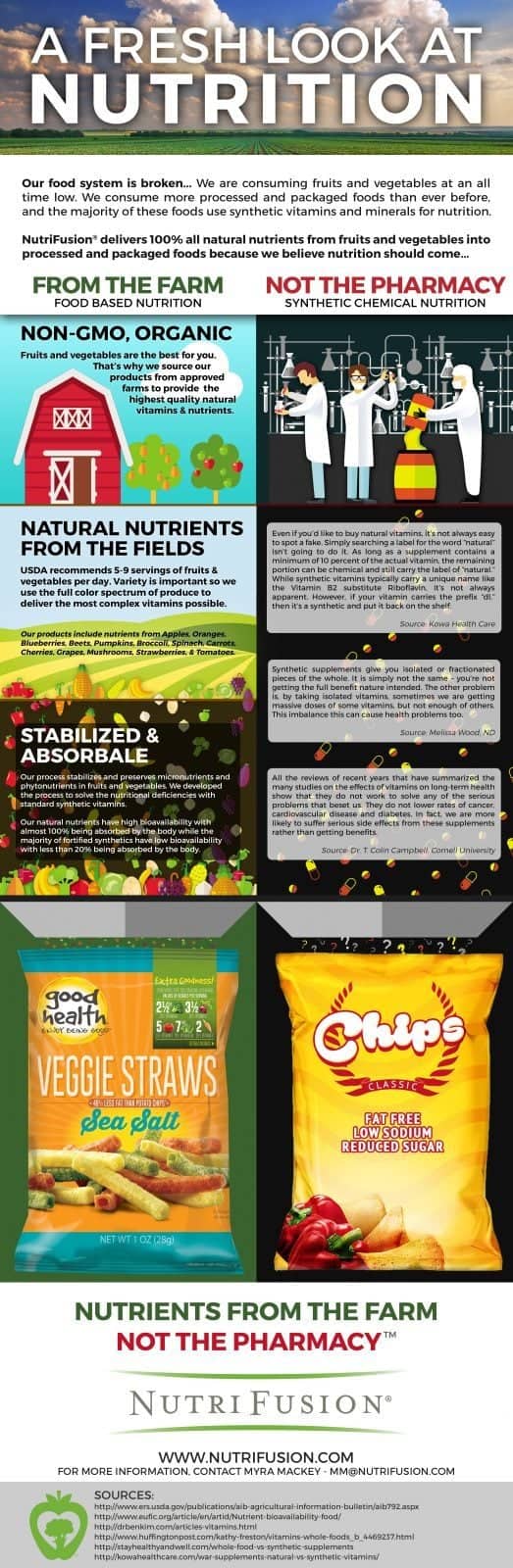
Below is an infographic that highlights the significant differences between natural vitamins and nutrients from NutriFusion® and the typical synthetic vitamins made in a lab. Enjoy!

Infographic: Natural vs. Synthetic Vitamins |NutriFusion

The trends in consumer food preferences are all pointing to healthier and more nutritious products. We have all been working to do this over the past fifty years, but we have faced grand challenges when delivering nutrients from natural sources in processed foods. We decided enough was enough, so we developed our patented process for stabilizing the vitamins and nutrients in fruits and vegetables. NutriFusion® is a leading food ingredient technology for food companies looking to deliver natural vitamins and nutrients in their packaged food products. We help you use simpler ingredients and create a “clean label” for your consumers. If you are interested in learning more about NutriFusion® for your processed foods, beverages, or supplements, please click below.

https://nutrifusion.com/wp-content/uploads/2016/02/shutterstock_123726274-e1454378981502.jpg 800 800 NF Admin https://nutrifusion.com/wp-content/uploads/2022/05/NutriFusion-Logo-New-1030x251.png NF Admin2016-02-02 08:30:292016-02-02 08:30:29Infographic: Natural Vs. Synthetic Vitamins

Adults Not Meeting Daily Value of Fruits and Vegetables

in Consumer Packaged Goods, Health & Nutrition, Kid's Health

Eating more fruits and vegetables reduces the risk of heart disease, strokes, some cancers, and also adds vital nutrients to our diets. When consumed in place of more energy-dense foods, vegetables and fruits can help in managing body weight. It is recommended that adults who engage in less than 30 minutes of moderate physical activity should consume 2 – 3 cups of vegetables and 1.5 – 2.0 cups of fruits daily.

There are two methods of determining the daily vegetable and fruit intake recommendations for adults who engage in less than 30 minutes of moderate physical activity daily. The first is the Behavioral Risk Factor Surveillance System (BRFSS) while the other is based on the Dietary Guidelines for Americans and is expressed in cup equivalents. However, a recent study conducted during 2007 – 2010 found that half of the total U.S. population consumed less than 1.5 cups of vegetables and less than one cup of fruit daily; 87 percent did not meet the daily value recommendations, and 76 percent did not meet fruit intake recommendations. National estimates indicate low fruit and vegetable consumption with substantial variation by state.

CDC’s Model Says Fruits and Vegetables Intake is Abysmal

Vegetable and fruit consumption information are available from the Behavioral Risk Factor Surveillance System (BRFSS), which is the sole source of dietary surveillance information for most states. However, the federal vegetable and fruit intake recommendations, expressed in cup equivalents are not directly comparable to the frequency of input captured by BRFSS.

The Center for Disease Control (CDC) did an analysis of the median daily frequency of vegetable and fruit intake based on BRFSS’s 2013 data for the District of Columbia and the 50 states. They applied newly developed prediction equations to BRFSS to calculate the percentage of the population of each state that meets vegetable and fruit intake recommendations.  The result was a bit disturbing. Overall, only 13.1 percent of the participants met the recommended fruit intake, ranging from 17.7 percent in California to 7.5 percent in Tennessee, and 8.9 percent met the recommended vegetable intake, ranging from 13.0 percent in California to 5.5 percent in Mississippi.  What this means is that a lot of effort is needed to build consumer demand for vegetables and fruits through placement, competitive pricing, and promotion in schools, child care, grocery stores, worksites, and communities.

Since vegetable and fruit consumption is currently low across all states and affects multiple health outcomes, continued efforts are needed to increase demand and consumption. Improving intake during childhood might be the key to improving fruits and vegetables consumption for adults.

Inspired by cdc.gov

NutriFusion® to the Rescue

All the research points to the health and nutrition benefits of consuming fruits and vegetables on a daily basis. The problem is we are not doing a good job as a society in encouraging that behavior and making fruit and vegetable nutrition readily available. This study by the CDC speaks to why we do what we do. Our special blends give consumer packaged food companies, beverage companies, and supplement companies the ability to incorporate natural nutrition from fruits and vegetables into their products. NutriFusion® is processing stable meaning that it can withstand the heating and cooling of modern day food processing. The NutriFusion® innovation is leading a revolution in the food industry to use simpler ingredients and make some of our favorite foods much better for us. If you are interested in learning more about NutriFusion® for your processed foods, beverages, or supplements, please click below.


https://nutrifusion.com/wp-content/uploads/2016/01/shutterstock_99130064-e1453860153985.jpg 850 850 NF Admin https://nutrifusion.com/wp-content/uploads/2022/05/NutriFusion-Logo-New-1030x251.png NF Admin2016-01-27 09:35:152016-01-27 09:35:15Adults Not Meeting Daily Value of Fruits and Vegetables

Parkinson’s Disease Risk Reduced in Coffee Drinkers

in Beverages & Drinks, Health & Nutrition

Do you know that a cup of coffee each day could keep Parkinson’s Disease away? According to a recent study, coffee consumers are less susceptible in developing Parkinson’s Disease compared to non-coffee drinkers.

Read more

https://nutrifusion.com/wp-content/uploads/2022/05/NutriFusion-Logo-New-1030x251.png 0 0 NF Admin https://nutrifusion.com/wp-content/uploads/2022/05/NutriFusion-Logo-New-1030x251.png NF Admin2016-01-25 11:16:182016-01-25 11:16:18Parkinson’s Disease Risk Reduced in Coffee Drinkers

Dairy Products Better Suited for Delivering Probiotics than Supplements

in Health & Nutrition, Supplements & Nutraceuticals

Have you ever eaten any dairy products fortified with live bacteria before? Probiotics are good bacteria and yeast that provide a variety of health benefits. These are often available in milk products and yoghurt as well as supplements.

Read more

https://nutrifusion.com/wp-content/uploads/2022/05/NutriFusion-Logo-New-1030x251.png 0 0 NF Admin https://nutrifusion.com/wp-content/uploads/2022/05/NutriFusion-Logo-New-1030x251.png NF Admin2016-01-22 11:43:282016-01-22 11:43:28Dairy Products Better Suited for Delivering Probiotics than Supplements

FDA Says No More “Unsafe” Trans Fats

in Consumer Packaged Goods, Food Business, Health & Nutrition

In a bid to reduce heart attacks and heart disease among Americans, the U.S. Food safety regulators have decided to ban a primary source of artificial trans fats in processed foods. According to the Food and Drug Administration (FDA), partially hydrogenated oils (PHOs) are not “generally recognized as safe” for human consumption. PHOs are an important source of artificial trans fat in the diet of many Americans.

The regulators have given food manufacturers until June 18, 2018 (3 years) to remove PHOs from food products. The food safety regulators feel this is enough time for food manufacturers to ask the FDA for permission to use foods that contain PHOs or to reformulate their products to eliminate PHOs. The regulators say that at the end of the compliance period, no food manufacturer will be allowed to add PHOs to human food unless they have been permitted by the FDA to do so.

FDA’s Ostroff Sees Link Between Trans Fats and Heart Health

Dr. Stephen Ostroff, FDA’s Acting Commissioner, says this action is expected to prevent thousands of fatal heart attacks every year and reduce coronary heart disease. The FDA anticipates that many companies will achieve compliance with the deadline since some companies are already removing PHOs from their processed foods. Following consultations with experts and a review of the scientific evidence, a preliminary determination to regard PHOs as unsafe for human consumption was announced by FDA in 2013. Currently, regulators are in the final stages of the resolution after taking into consideration the comments from the public.

According to Dr. Susan Mayne, the Director of the FDA’s Food Safety and Applied Nutrition Center, the determination is based on the input from all stakeholders received during the public comment period, as well as extensive research into the effects of PHOs. Food companies use artificial trans fats to increase the stability of processed foods, extend their shelf life, and improve their texture. This is because they are more readily available and cheaper than natural versions from dairy and meat sources. Since 2006, companies have had to show trans fat content on the nutrition facts labels of food products sold in the US.

The primary sources of PHOs in the American diet are savory snacks such as coffee creamers, microwave popcorn, ready-to-use frosting, and frozen pizza. Other sources include cakes, pies, cookies, fried foods, kinds of margarine, and spreads. PHOs are bad for health because consuming them increases “bad” cholesterol ( LDL) and lowers “good” cholesterol (HDL) in the body, raising the risk of coronary heart disease.

Inspired by www.medicalnewstoday.com

https://nutrifusion.com/wp-content/uploads/2022/05/NutriFusion-Logo-New-1030x251.png 0 0 NF Admin https://nutrifusion.com/wp-content/uploads/2022/05/NutriFusion-Logo-New-1030x251.png NF Admin2016-01-17 11:18:102016-01-17 11:18:10FDA Says No More “Unsafe” Trans Fats

Fish Oil May Reduce Risk of Alzheimer’s Disease

in Health & Nutrition

A new study funded by Abbott Nutrition has suggested that consuming more omega-3 fatty acids may benefit people at risk for Alzheimer’s disease – omega-3 fatty acids are found in many types of fish oil and other plant-based nutrition sources. Researchers looked at 40 mentally healthy adults aged 65 to 75 in the study. All of them had APOE e4, the gene variant that is known to increase the risk for late-onset Alzheimer’s. The researchers had an interesting finding. Those who consumed higher amounts of two omega-3 fatty acids, EPA, and DHA, had higher cognitive and mental flexibility. Though the results are not conclusive, they suggest that consuming EPA and DHA omega-3 fatty acids might improve mental flexibility by helping in increasing the size of the anterior cingulate cortex.

According to Aron Barbey, recent research suggests that there is a link between the degenerative neurological disorders and incidence of both cognitive impairment and nutritional deficiencies. Aron Barbey is the study co-leader and a professor of psychology, neuroscience, and hearing and speech science at the University of Illinois.

“Our findings add to the evidence that optimal nutrition helps reduce the incidence of debilitating diseases in healthy aging populations, slow the progression of aging, and preserve cognitive function.” – Aron Barbey

More Evidence Needed To Understand The Correlation Between Fish Oil and Alzheimer’s

The study was published online in the journal, Frontiers in Aging Neuroscience on May 21. However, it does not show that consuming EPA and DHA can prevent Alzheimer’s – the most common form of dementia. The study co-leader and a medical/doctoral student, Marta Zamroziewicz, said in the news release that the survey focused on areas of brain function sometimes overlooked in research on aging. Zamroziewicz added that many executive functions including cognitive flexibility had been shown to be better predictors of daily functioning than memory while most of the past studies in cognitive aging tend to focus on memory. Executive functions refer to skills such as impulse control, task switching, reasoning, problem-solving, planning, and paying attention. These are functions that tend to decline earlier than other cognitive functions in aging. Other foods like fruits and vegetables fight Alzheimer’s but fish oil could be the best because of its omega-3 content.

Inspired by www.cbsnews.com

Stabilized Omega-3 From NutriFusion®

NutriFusion® has developed a wide array of products to help food processors enhance the nutritional value in many of our favorite foods. Our primary products stabilize the micronutrients and phytonutrients from fruits and vegetables to deliver a consistent daily value of essential vitamins and minerals. We took that a step farther when we developed our stabilized Omega-3 products. If you are interested in learning more, please contact us below.

https://nutrifusion.com/wp-content/uploads/2022/05/NutriFusion-Logo-New-1030x251.png 0 0 NF Admin https://nutrifusion.com/wp-content/uploads/2022/05/NutriFusion-Logo-New-1030x251.png NF Admin2016-01-13 10:18:002016-01-13 10:18:00Fish Oil May Reduce Risk of Alzheimer’s Disease

Healthy School Lunches Are Under Attack

in Health & Nutrition, Kid's Health

The facts are out there, a significant proportion of children in the United States are battling obesity and a lot of it has to do with our school lunches. 27% of 17-24-year-olds in this country are unfit to join the military, and they are at significant risk of developing lifestyle diseases later in their lives. Parents demanded change in their children’s lunch menu and in 2010 the child nutrition bill was passed. Parents will not celebrate for long as there are proposals to reauthorize the program this year, which will see $ 11 billion to finance the school lunch nutrition program. Congress plans to reauthorize spending, but the programs that have been put in place earlier are at risk. Several players would like this to succeed, one party is the School Nutrition Association, a body that comprises of the school food directors and workers and receives most of their funding from the food industry.

Industry Players Disrupting the Nutrition Bill

Industry players like the potato lobby and frozen pizza makers have already lobbied against new proposals as the new bill’s requests would eat into their profits. Other suppliers are in this for the same reason; their profits have dropped due to children eating healthy. Many of the new proposals for the bill are attacking essential aspects to a healthy diet like whole grains, fruits, and vegetables.  Another example of a sneaky plan is for “Smart Snack Program,” this program would include salty, high calories snacks to kids instead of more healthy alternatives. It’s imperative that we stand strong and keep working to build healthier school lunches for our children. 

There are a few people who believe that healthier meals have led to increased food waste. Healthy foods have never been a kid’s favorite. As kids, we always preferred sweet and salty food, which is why making a change to healthier food is hurting a lot of food manufacturers. The key to ensuring that food waste is minimized without having to give the children junk is creating healthy meals that are more appetizing. This idea has worked perfectly well in some schools, and it can work in others too.

Inspired by www.usatoday.com


NutriFusion® for School Lunches

Food manufacturers that provide processed foods to schools need to develop healthier and more appetizing products. That’s a tough combination to strike, but it is the key to sustainable competitive advantage in the school lunch market. Health and nutrition are driving forces in the food industry, and we have to find ways to better our food system for the generations to come. We recommend you take a look at our GrandFusion® products. They are unique blends of organic, non-GMO fruits and vegetables that deliver the 50% of the daily value of natural vitamins and minerals. Our mixes go through a patented, stabilization process so that the micronutrients and phytonutrients can withstand the heating and cooling of modern day processing. If you are interested in learning more about our products, please review the website or contact us below.


https://nutrifusion.com/wp-content/uploads/2022/05/NutriFusion-Logo-New-1030x251.png 0 0 NF Admin https://nutrifusion.com/wp-content/uploads/2022/05/NutriFusion-Logo-New-1030x251.png NF Admin2016-01-08 09:47:022016-01-08 09:47:02Healthy School Lunches Are Under Attack

Sugary Drinks May Damage Heart Health

in Health & Nutrition, Kid's Health

The latest Harvard research review is confirming what everyone feared, there are negative effects associated with sweetened drinks on our heart health. It has been known that they have negative effects, but most of us did not associate them with heart conditions. The review by Vasanti Malik, a nutrition research scientist from Harvard, points out that taking one or two servings of sweetened drinks increases your risk of a heart attack. This is not the only effect, this sugar also puts the consumer at risk of a stroke and type 2-diabetes. According to the review, reducing the intake may not solve the problem but it is one step towards reducing the risk.

Heart Health And Sugar Don’t Mix

The review puts a new focus on heart health risks; previously the main attention was on fat and cholesterol reduction. The impact of sugar was not very profound; with this report, people need to start paying serious attention to what beverages they consume on a daily basis. The understanding that sweetened drinks have similar effects as cholesterol and fats is an eye opener. Perhaps this will make people reduce their intake or get rid of sweetened drinks altogether. One of the most widely consumed sweetened drinks is soda; it is known to contain 35 grams of sugar, an equivalent of nine teaspoons.

Glucose and fructose are the culprits; they both cause heart diseases among other conditions. Glucose causes your level of insulin to rise, an effect that leads to the development of type 2-diabetes. Fructose apart from causing heart disease also triggers the liver to release bad cholesterol. When fructose is consumed in large quantities it can cause fatty liver disease and production of excess uric acid in the blood system, this is the main cause of heart disease, gout, and inflammatory arthritis. For those who may be worried about belly fat, consumption of fructose has been associated with its accumulation. Accumulation of belly fat is a directly associated with dysfunctional heart health.

Beverage Manufacturers Challenge The Claims

Malik’s review, as expected has been challenged by the beverage makers; they claim that the report unfairly targets their industry. They argue that the same zeal that the researchers condemn sweetened sugars should be applied to product sugars since the body process both of them in a similar way.

The researchers are sticking to their ground and they insist that the processed sugar is absorbed rapidly in the body increasing the chances of harming the body organs. The United States Department of Agriculture proposes that manufacturers will be required to identify the amount of sugar in the product in relation to that which occurs naturally. Consumers have been urged to avoid added sugars until such measures have been put in place.

Inspired by consumer.healthday.com

Replace Sugar With a Natural Sweetener, NutriFusion®

NutriFusion® could be the answer to your sweetener problems. Our products are created from natural, non-GMO fruits and vegetables. Instead of adding sugar, add important micronutrients and phytonutrients to your beverages with NutriFusion®.

Why NutriFusion®?

We patented a method to stabilize the vitamins, minerals, and nutrients in fruits and vegetables through all the stages of modern day processing. Our products have a typical two-year shelf life. If you are interested in learning more about NutriFusion® for beverages, click the button below.

https://nutrifusion.com/wp-content/uploads/2022/05/NutriFusion-Logo-New-1030x251.png 0 0 NF Admin https://nutrifusion.com/wp-content/uploads/2022/05/NutriFusion-Logo-New-1030x251.png NF Admin2016-01-06 10:40:532016-01-06 10:40:53Sugary Drinks May Damage Heart Health
Page 52 of 54«‹5051525354›»

NUTRIFUSION®

GrandFusion® is a blend of fruits and/or vegetables that can significantly increase the nutritional profile and, therefore, the marketability of food, beverage, pet, and snack products.

Categories

  • Animal Nutrition
  • Beverages & Drinks
  • Consumer Packaged Goods
  • Corporate Partnerships
  • Corporate Updates
  • Featured
  • Food Business
  • Food Retail
  • GLP-1
  • Health & Nutrition
  • Infographics
  • Kid's Health
  • News
  • Press Releases
  • Product Announcements
  • Recipes
  • Supplements & Nutraceuticals
  • Uncategorized

ABOUT NUTRIFUSION®

NutriFusion® provides the nutrient-rich benefits of fruits and vegetables in everyday food products through whole non-GMO foods to create its concentrated micronutrient and phytonutrient-rich food ingredient blends.

Search NutriFusion

Search Search

SEAL OF AUTHENTICITY

NUTRIFUSION® CERTIFICATES

NutriFusion Cert Bar

Categories

  • Food
  • Beverages & Drinks
  • Pet Food
  • Nutraceuticals
  • Contact Us
  • Privacy Policy

© Copyright 2026 NutriFusion LLC | All Rights Reserved.

Scroll to top Scroll to top Scroll to top