
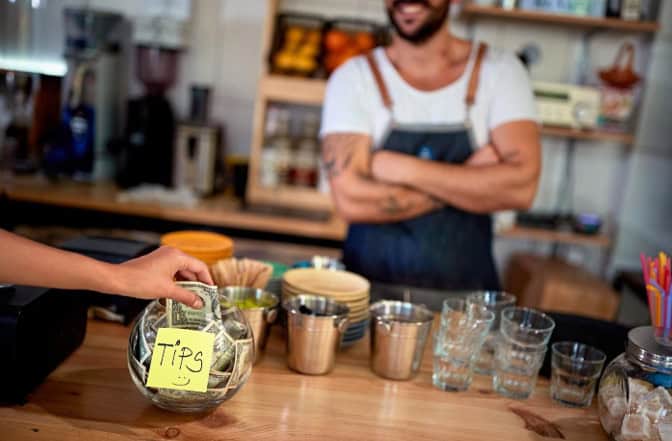
Do you tip when you’re dining at a restaurant, with waiters and waitresses tending to your needs? Most likely, the answer is yes. But what about at self-checkout, take out, and drive-thru?
Tipping is an established way of life; however, an uptick in tipping pressure – whether it be direct or through the presence of tipping option screens and tip jars – is putting consumers in a position where they are feeling burned out by a shifting social expectation. Pairing this with the awareness that many of today’s workers rely on tips as a substantial part of their income (for nearly 70% of restaurant servers, tips account for more than half of their income, struggling with hourly wages as low as $2.13), questioning the “expectation” racks up serious feelings of guilt.1
It’s essential that today’s businesses keep this shift in customer sentiment top of mind, as well as the needs of employees. The question becomes: Businesses, how are you adapting to this shift in tipping culture? Because without addressing the financial burnout of customers, as well as those who drive your operations, you could be positioning yourself for a serious financial downfall.
Capitalizing on Dire Need
Tipping is so deeply rooted in history that it’s no wonder we are grappling with how to best address a tipping culture-related issue – a delicate dance that affects so many.
This service-oriented phenomenon has been a large part of the U.S. economic structure for some time, originating from the post-Civil War time period when many of those who had been enslaved searched for employment to establish new lives.2 Much of these attempts were sought in service industries, such as restaurants and hotels. Unfortunately, the large wave of those seeking jobs enabled business owners to leverage that need into offering very low compensation.3 This is how the reliance on tips to supplement income was born, leading to an unsteady economic tightrope that leaves tip-reliant workers hopeful that the customers who come into establishments will be generous.
The Frustrated Consumer Perspective
But the challenges do not end on the service side. The tangled web of tipping has put today’s consumers in a very challenging situation as most recognize the need for tipping but are becoming increasingly frustrated and confused with the recent shift in tipping culture.
In September 2025, Popmenu conducted a survey of 1,000 individuals, ages 18 and older, across the U.S. The findings were quite telling, with one standout finding being 65% of participants saying they are fed up with tipping, which is an increase from 60% in 2024 and 53% in 2023.4 What’s more, respondents shared that they are asked to tip for different services on average 10 times each month, which is a big reason why 43% say they’re tipping less this year.5
But these new attitudes are also interesting due to an emotional component that can often play a role in consumerism: serious feelings of guilt. Feedback from participants in Popmenu’s survey indicates:6
- At least once a week, 44% tip at establishments where they don’t think it’s customary or needed
- 66% feel pressured to tip when digital payment screens suggest gratuities, especially when in front of employees
- Due to “guilt tipping”, 64% have tipped a worker even when they received poor service
- 52% have added gratuities when they felt bad for a worker
- 45% tip so they aren’t perceived as cheap
The intense psychology around tipping for various services is bound to impact the relationship between consumers and the establishments they patron – ultimately affecting the bottom line.
“Tipflation” Ignorance is Not Bliss
So, while on the topic of tipping, businesses, here’s a tip for you: As an establishment chasing revenue, it’s crucial to keep in mind the infrastructure that drives your business, and that without consumers and hard-working employees that drive operations, you will be left with nothing but a pile of rubble.
Consider how you compensate employees and ensure that they receive a livable wage so that tipping is a nicety and not a desperate need. This will allow you to reduce the number of platforms for tipping (e.g., digital tipping prompts when making a quick purchase that requires little service) to reduce the guilt and frustration that consumers experience. This shift, while perhaps a little challenging, will ultimately benefit your business in the long run.
NutriFusion
NutriFusion develops all‐natural fruit and vegetable powders that are nutrient dense for when you do not have access to fresh produce…and even when you do to improve your vitamin intake. Sourcing only whole, non-GMO foods, NutriFusion offers consumers a concentrated micronutrient and phytonutrient-rich food ingredient blends. With a farm-to-table philosophy, NutriFusion’s proprietary process stabilizes the nutrients from perishable fruits and vegetables, allowing a longer shelf life and access to vital nutrients.
NutriFusion fruit and/or vegetable powders are for use in foods, beverages, supplements, and pet foods. NutriFusion can help! Visit us at www.nutrifusion.com.
——————————————————————————————————————————-
References
- The Tipping Point: A Conversation About Tipping Culture. University of Notre Dame website. https://freshwriting.nd.edu/essays/the-tipping-point-a-conversation-about-tipping-culture/
- The Tipping Point: A Conversation About Tipping Culture. University of Notre Dame website. https://freshwriting.nd.edu/essays/the-tipping-point-a-conversation-about-tipping-culture/
- The Tipping Point: A Conversation About Tipping Culture. University of Notre Dame website. https://freshwriting.nd.edu/essays/the-tipping-point-a-conversation-about-tipping-culture/
- 77% of Consumers Say Tipping in the U.S. Has Become Ridiculous, According to Popmenu’s Annual Study. PR Newswire press release. https://www.prnewswire.com/news-releases/77-of-consumers-say-tipping-in-the-us-has-become-ridiculous-according-to-popmenus-annual-study-302577741.html October 8, 2025.
- 77% of Consumers Say Tipping in the U.S. Has Become Ridiculous, According to Popmenu’s Annual Study. PR Newswire press release. https://www.prnewswire.com/news-releases/77-of-consumers-say-tipping-in-the-us-has-become-ridiculous-according-to-popmenus-annual-study-302577741.html October 8, 2025.
- 77% of Consumers Say Tipping in the U.S. Has Become Ridiculous, According to Popmenu’s Annual Study. PR Newswire press release. https://www.prnewswire.com/news-releases/77-of-consumers-say-tipping-in-the-us-has-become-ridiculous-according-to-popmenus-annual-study-302577741.html October 8, 2025.