• Link to LinkedIn
  • Link to Facebook
  • Call Us
NutriFusion
  • Applications
    • All Blends
    • Food
    • Beverages & Drinks
    • Nutraceuticals
    • Pet Nutrition
    • Custom Superfood
  • R&D
    • Research & Development
    • Vitamin Deficiency
  • Active Research
  • About
    • About NutriFusion®
    • Certifications
  • Contact
  • News
    • Press Center
  • Podcasts
  • Blog
  • Store
  • Click to open the search input field Click to open the search input field Search
  • Menu Menu

Archive for category: Food Business

Annie’s Wants Organic To Be Affordable For All Consumers

in Beverages & Drinks, Consumer Packaged Goods, Food Business, Kid's Health

The rise of organic food is creating waves all over the United States. The news circulating about the dangers of eating foods laced with pesticides and other harmful agricultural chemicals is shifting people towards clean eating. Consumers are seeing the benefits of eating organic products. However, the accessibility of organic foods is mostly exclusive to people who can afford them. In reality, not everyone can afford to buy a pound of strawberries for $15. It is just too much!

Fortunately, there are now organic companies trying to reach out to a broad spectrum of consumers. The all-American favorite food company Annie’s is encouraging people to eat food products made from organic ingredients by launching new healthy and price sensitive products.

Annie’s Leading Revolution in Affordable Organic Foods

A survey conducted by the USDA in April 2016, reveals that only 23% of American consumers can afford to buy organic foods. With the rising cost of organic food, it is no wonder why many people cannot afford to buy organic even though they are now available in most grocery stores.

Poor nutrition is a big problem in the United States. Poor nutrition is often translated to high obesity rates in the country. Having seen this issue progress over the years, Annie’s has vowed to launch at least 30 new products made from certified organic ingredients.  These organic products will be sold in the form of soups, yogurts, cereals, and baking mixes. The acquisition by General Mills has opened doors to supply chains that Annie’s never thought was possible.

John Foraker, Annie’s President, noted that the company has been passionate about making organic foods for decades and this principle not only benefits the farmers and consumers but the planet as a whole. Moreover, the company believes that organic foods should not be restricted to people on high social and economic tiers. The company’s decision to make their foods available to people from all income levels is ground-breaking on its own.

To fortify its new campaign, Annie’s launched an integrated digital campaign which helped the growth of the company. With the launch of the new campaign on August 19 of 2016, it allowed people to find out about the exciting campaign and participate in it by buying the new products.

So what is the implication of Annie’s campaign on the rest of the industry? Perhaps this bold move by the company will push the other primary players of the industry to opt for the wider distribution of organic foods thereby increasing the accessibility of healthy foods to all consumers. Will this happen in the future? We can only hope so.

Inspired by prnewswire.com

https://nutrifusion.com/wp-content/uploads/2016/09/portion-of-macaroni-and-cheese-MKUWLHD-min.jpg 1030 1543 NF Admin https://nutrifusion.com/wp-content/uploads/2022/05/NutriFusion-Logo-New-1030x251.png NF Admin2016-09-30 09:11:472016-09-30 09:11:47Annie’s Wants Organic To Be Affordable For All Consumers

Beverage Giant, PepsiCo, Joins The Organic Bandwagon

in Beverages & Drinks, Food Business

Food and beverage manufacturers are revamping their products by using organic and natural ingredients. One company that has recently joined the bandwagon is PepsiCo.

PepsiCo is launching a new version of Gatorade that has been certified organic by the USDA. The new product is devoid of any artificial flavoring and coloring. PepsiCo is releasing the new product to adapt to the growing natural food movement in the United States amongst athletes.

This is not the first time the company has changed ingredients found in Gatorade. In the past, it has removed some ingredients like brominated vegetable oil (BVO) after the company has been criticized online for using a questionable ingredient. However, this time, PepsiCo will launch organic Gatorade as a new product line with a higher price than traditional Gatorade.

Beverage Companies Like PepsiCo Must Give Consumers the Option

Gatorade controls 70% of the sports drink market, but it faces pressure from newcomers like coconut water which is favored by many people. Moreover, the organic food industry has increased its sales to $43.3 billion in 2015 which is equal to 11% of the total consumer food and beverages sales.

It took the company two years of research before it could launch the new line of products. Today, the company released different flavors of organic Gatorade such as lemon, mixed berry, and strawberry in Kroger for the initial beverage launch. Gatorade’s senior vice president Brett O’ Brien noted that the company aims to expand the distribution of the product to many natural convenience stores as well as select groceries.

Ordinary consumers are not the only ones who prefer to drink organic beverages. Athletes, who are the biggest consumers of Gatorade, want to go organic. According to the survey conducted by Gatorade, 12% of athletes show interest in buying organic products.

Revamping Gatorade to an all-natural product means that the company had to shed all artificial ingredients and refine its manufacturing practices. One of the major concerns from consumers is a change in taste because of the significant changes in ingredients.  PepsiCo assures its current customers that the taste will remain the same without sacrificing the nutritional value.

This bold move is not only observed in PepsiCo. Other companies have also shifted and joined the natural movement. For instance, General Mills has stopped using artificial ingredients in some of its cereal products while Kraft Heinz Co. released an organic version of its fruit juices.

While the product is sold at $0.50 more than the non-organic equivalent, the company is still confident that people will patronize the product because of its organic claim. After all, many consumers are now after organic products, and this is what the new Gatorade is all about.

Inspired by bloomberg.com

https://nutrifusion.com/wp-content/uploads/2022/05/NutriFusion-Logo-New-1030x251.png 0 0 NF Admin https://nutrifusion.com/wp-content/uploads/2022/05/NutriFusion-Logo-New-1030x251.png NF Admin2016-09-27 08:48:062016-09-27 08:48:06Beverage Giant, PepsiCo, Joins The Organic Bandwagon

Kid’s Menus Should Not be a Marketing Gimmick

in Food Business, Health & Nutrition, Kid's Health

Are you raising picky eaters? Then you will be surprised with the recent trend of restaurants offering healthier kid’s menus. Gone are the days when your only fast food option was chicken nuggets, burgers, and fries.

Over the past few years, various restaurants started providing dishes that contain ingredients that your kids might not currently eat. For instance, the restaurant chain, Laughing Planet Café, is offering healthy options for their young diners that are made from tempeh (a soy product), quinoa, and kale. On the other hand, some restaurants also give children the freedom to choose healthy items to match their foods like brown rice, roasted yam, or tofu.


Healthy Trend Leads Transformation of Kid’s Menus

What is influencing this trend? Franz Spielvogel, CEO of Laughing Planet, noted that they are embracing such bold moves because modern parents are becoming more educated and health-conscious. Moreover, diners now have more access to different flavors and children grow up in households that eat a variety of cuisines.

Another reason why restaurants across the United States are changing their kid’s menus is that most adults think that kid’s menus are not given too much thought. Most of the dishes included in the menu appeal to the kids taste-wise, but their nutritional value was never taken into account. Kid’s menus should be more than a marketing gimmick. Although this may be the case, traditional burgers will never go away; but restaurants are making moves to incorporate healthier ingredients in their burgers to provide more variety and nutrition to children.

This trend has pushed other food companies to revamp their products to become healthier for children. For instance, Panera Bread Co. will offer its kids menu minus the sweeteners, artificial flavors, and colors. Diners can expect to see black bean soup and Greek salad on its new kid’s menu.

How to Make Healthy Foods More Appealing to Kids

Aside from creating new and healthier products for children, companies are also looking into how the foods will be presented to children. MAD Greens, a food chain that has branches in Utah, Texas, Colorado and Arizona, devised a way to make their food boxes more appealing even if it contains edamame, pasta, and citrus chicken–not your child’s usual favorites.

Giving children more control to foods they eat is also the key to letting them develop healthy eating habits even while dining out. According to Molly Siegler, culinary editor at Whole Foods Market, if children are allowed to participate in choosing which vegetables they want in their soup, then they are likely to eat the finished product. Letting children have control on the kinds of foods that they consume is necessary as long as they have their parents guiding them in the right direction.

Restaurants today are embracing the fact that they are accountable when it comes to feeding young diners with not only delicious but also nutritious foods. This revolution is reshaping the food industry, and it might help provide the solution to the obesity problem among children.

Inspired by marketwatch.com

https://nutrifusion.com/wp-content/uploads/2016/09/lunch-boxes-for-kid-healthy-snack-for-school-LBSA8H3-min.jpg 1030 1545 NF Admin https://nutrifusion.com/wp-content/uploads/2022/05/NutriFusion-Logo-New-1030x251.png NF Admin2016-09-22 09:31:392016-09-22 09:31:39Kid’s Menus Should Not be a Marketing Gimmick

Nielsen Says Consumers Are Now Ingredient Inspectors

in Animal Nutrition, Beverages & Drinks, Consumer Packaged Goods, Food Business, Health & Nutrition, Kid's Health

With the advent of healthy living and clean eating, more people all over the world now practice due diligence when it comes to their food. In the recent Nielsen’s Global Health and Ingredient-Sentiment Survey, 70% of the respondents said that they make dietary choices to avoid health problems like diabetes, high blood pressure, and obesity. Nielsen has nicknamed these consumers the “ingredient inspectors.”


People Are Willing to Pay More for Healthy Foods

Around 68% of the respondents surveyed agreed that they are willing to pay more for healthy food and beverages. This was supported by U.S. retail sales data which indicated that the sales of health and wellness products are outpacing other types of fast-moving consumer goods.

According to Director Andrew Mandzy from Neilsen’s Strategic Health and Wellness Insights group, most consumers want to eat healthily. But they need the commitment from food manufacturers to create products that are made from simple and clean ingredients. Consumers depend on food companies to develop “better-for-you” products that are still convenient for their busy lifestyles.


Reasons for The Rise in Ingredient Inspectors

So why is there a rising trend in the food and wellness industry? Perhaps one of the reasons is food sensitivity or intolerance. The same survey conducted by Neilsen indicated that 36% of the respondents revealed that they opted for healthy foods because they are suffering from allergies or live with someone who does. The rise of lactose intolerance and seafood allergies was cited by 12% of the respondents.

Aside from food allergies, many consumers are actively excluding several ingredients from their diets. This motivation to eliminate certain foods can be brought about by religious influences or just small lifestyle decisions. Regardless, 64% of the respondents follow diets that prohibit certain foods or ingredients. For instance, 84% of the African and Middle Eastern respondents reveal that they follow a special diet as cited by their religion.  Respondents from Asia-Pacific scored 72% on the survey indicating that they support it for lifestyle and religious purposes. Most of them adhered to a vegetarian diet as reflective of their beliefs. Only 44%  of people living in North America and Europe cited motivation from religion to exclude ingredients in their food.


In the global survey, it was indicated that sugar is the most common ingredient that is eliminated by 31% of the respondents. Others limit their intake of carbohydrates and sodium for health reasons. Many of the interviewees are well aware of the effects caused by the foods they eat. In fact, 75% of people are anxious about the long-term impacts of incorporating synthetic ingredients into their food. Most of the respondents avoid foods that contain preservatives, coloring, and artificial flavors.

Consumers are demanding better food, and it’s up to food companies to supply this growing demand. It’s up to food companies to capitalize on the new opportunity and win customers with new healthy options.

Inspired by nielsen.com

https://nutrifusion.com/wp-content/uploads/2022/05/NutriFusion-Logo-New-1030x251.png 0 0 NF Admin https://nutrifusion.com/wp-content/uploads/2022/05/NutriFusion-Logo-New-1030x251.png NF Admin2016-09-20 08:48:522016-09-20 08:48:52Nielsen Says Consumers Are Now Ingredient Inspectors

USDA Reported Trends in Consumption of Fruits and Vegetables

in Food Business, Health & Nutrition

Although there is a strong campaign for Americans to eat fruits and vegetables, the Economic Research Service (ERS) noted that the total consumption of fresh fruit and vegetables have fallen from 299 pounds to 272 pounds per person within ten years. The study was conducted from 2003 to 2013. The widespread decline of eating fruits and vegetables can pose serious threats to overall health. This article will discuss the trends reported by the USDA regarding the consumption of fresh fruit and vegetables.

Potatoes Cause the Decline of Vegetable Consumption

The USDA observed a decline in the consumption of the total number of vegetables, which was driven by the reduced consumption of potatoes. Boys between the age of 2 and 19 consumed only 45.2 pounds in 2008 as opposed to the 63.7 pounds per person annually. So why is vegetable consumption affected by the decline of potato consumption? The reason probably is that potatoes, as a staple food for most American families, are often mixed with other vegetables. Although this data suggests a grim result, it also revealed that consumption of some vegetables like broccoli, leafy greens, cauliflower, and peppers have increased.

low-calorie foods 1

Higher Income is Directly Correlated to Vegetable Consumption

Researchers observed that people from households with incomes below the poverty level consumed fewer vegetables than those above the poverty line. Education plays a crucial role in making healthy food choices. In the study, college-educated adults consumed 187.4 pounds of vegetables compared to those who only attained high school education (181.9 pounds). While the quality of education can affect the food choices of people, the trend is fueled by their economic power. The ability to afford more nutritious foods is higher for college-educated adults than those who only have a high school education.

Whole Fruit Consumption is Not Consistent for Demographic Groups

There is a decline in the consumption of orange juice across all demographic groups. However, the trend of whole fruit consumption is not compatible. This can be a problem since many consumers are not taking the recommended daily intake of fiber from fruits. It had declined from 71.9 pounds per person annually from 1998 to 65.4 pounds in 2008. Again, this can be attributed to the income status of a person as well as the cultural background.

grocery store produce

USDA Says Substitution is Becoming a Norm

Substituting the products is becoming evident among many consumers. For instance, many users use leafy greens like spinach or kale instead of lettuce.  While there is a decline in the consumption of citrus fruits, it has been found that most consumers prefer to eat berries instead. One of the reasons for this trend is that consumers are opting for ingredients that are healthier.

Inspired by ers.usda.gov

https://nutrifusion.com/wp-content/uploads/2016/08/shutterstock_158769677-e1473861354735.jpg 800 1200 NF Admin https://nutrifusion.com/wp-content/uploads/2022/05/NutriFusion-Logo-New-1030x251.png NF Admin2016-09-14 10:17:562016-09-14 10:17:56USDA Reported Trends in Consumption of Fruits and Vegetables

Infographic: What do Millennials Eat?

in Consumer Packaged Goods, Food Business, Health & Nutrition, Infographics, Kid's Health

As we already mentioned in this article, the millennials are currently the most exciting generation of product and service companies because of their buying power, shopping demands and capacities. One of the things that the millennials do not feel sorry paying for is food. Research shows that they spend more money on food than previous generations, and they are quite picky and opinionated about their food choices. They are in the loop about trendy restaurants, curious about food ingredients, and they carefully read food reviews in magazines and online media. Consequently, the appetites and eating habits of the Millennials are different, and food producers need to keep up with the change in the food scene to cater to desires of this growing population.

The following infographic presents information about the eating habits of the Millennials and the factors that shaped them, from the digital revolution to economic and obesity crisis. Take a look and discover some interesting and contradictory information related to this topic, find out what the millennials typically have for lunch, and have fun reading about the eating habits of some of the famous millennial celebrities.

millennials eating habits food and beverage


https://nutrifusion.com/wp-content/uploads/2022/05/NutriFusion-Logo-New-1030x251.png 0 0 NF Admin https://nutrifusion.com/wp-content/uploads/2022/05/NutriFusion-Logo-New-1030x251.png NF Admin2016-09-12 11:07:572016-09-12 11:07:57Infographic: What do Millennials Eat?

Developer Creates More Visual Food Data With Interactive App

in Beverages & Drinks, Consumer Packaged Goods, Food Business, Health & Nutrition, Supplements & Nutraceuticals

More consumers are reading food labels than ever before. Customers expect packaged foods to contain the appropriate and promised ingredients. A developer has reinvented food data by launching a new web app, Sage Project. Co-founded by Sam Slover and backed by the FDA, the Sage Project is an online platform that gives food data and labels a new visual understanding of what we are eating.


The Sage Project

The project deconstructs thousands of food products–both fresh and packaged–into a personalized, interactive platform that contains necessary information you would find in conventional food labels. The information accessed with this app includes nutrients, calories, allergens, vitamins, and ingredients. But aside from providing food data, the developer wanted to communicate the nutritional content and what it means in the context of the health of an individual. The app also contains information on how it affects the fitness goals and activity levels of a person.

The app itemizes all the ingredients regarding weight in a list. While it is straightforward enough, the developer also ensured that the ingredients and nutrients also change depending on the serving size. This gives consumers a clear idea of how much of a particular ingredient or nutrient they are getting from the food in a specific amount.


Why People Are Not Reading Food Labels

There is a big reason why most consumers do not read food labels. While it takes some time getting used to reading food labels, conventional food labels are downright boring to look at. In a study conducted by researchers from the University of Minnesota, they revealed that one of the biggest reasons why people are not looking at labels is because they do not have strong visuals.

To solve this problem, the Sage Project deconstructed the traditional food label into an infographic. A list of the five most abundant nutrients of the food product is located at the top of the page, while an analysis of the nutritional content is found beneath it.

The app also features the types of exercises needed to burn off a particular food item when eaten; while an annotated list of ingredients including allergens is found in the lower part of the screen. Since most of the consumers are not familiar with some of the ingredients used in making a product, there are information icons beside each ingredient that you can scroll through to understand that particular ingredient better.


The Drawbacks to The Sage Project Food Data

The Sage Project provides a lot of information, which is one of its drawbacks. Some people just want their food labels to be straightforward. With so much information, some people may find the entire app overwhelming. However, the visual appeal of the data makes it easy to comprehend for the more data savvy generation, millennials.


According to Angela Lemond from the Academy of Nutrition and Dietetics, consumers might experience information overload when using this app. But nevertheless, this app can be customized to fit any customers’ dietary restrictions as well as health goals. What matters is that this app can help a lot of people make the right health decisions when it comes to their food.

Inspired by wired.com

https://nutrifusion.com/wp-content/uploads/2022/05/NutriFusion-Logo-New-1030x251.png 0 0 NF Admin https://nutrifusion.com/wp-content/uploads/2022/05/NutriFusion-Logo-New-1030x251.png NF Admin2016-09-07 10:15:522016-09-07 10:15:52Developer Creates More Visual Food Data With Interactive App

New Research: Food Shopping Habits of Millennials

in Beverages & Drinks, Consumer Packaged Goods, Food Business, Infographics, Supplements & Nutraceuticals

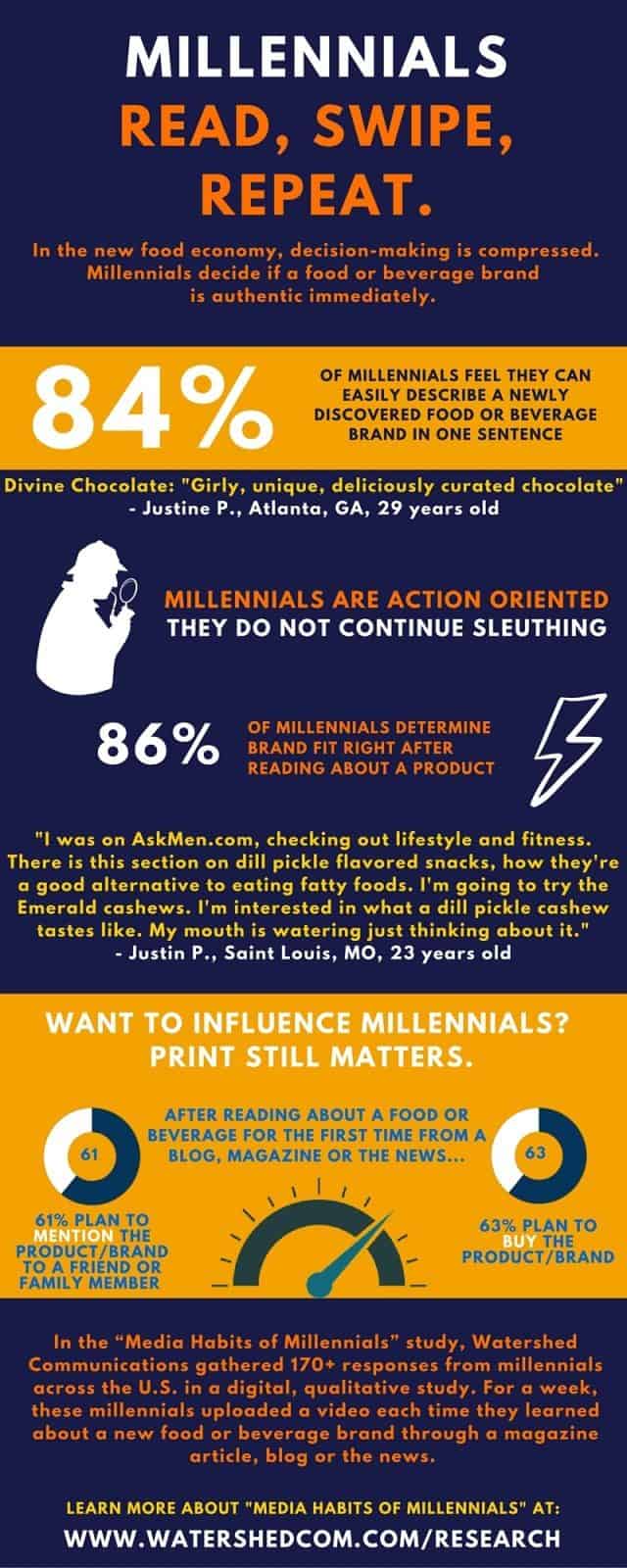
The food landscape is ever changing, and so does the behavior of people. Watershed Communications, a national brand strategy agency, conducted a study regarding the food shopping habits of Millennials. The participants, aged 18 to 35 years old, were asked to describe a food brand that they found authentic. They also had to answer questions related to their food shopping habits.

Millennials are considered the most highly engaged shoppers in all demographics. They are also the ones who have more shopping demands and higher capacities. With this study, companies will be able to understand the food shopping habits of Millennials so that they can apply the information in developing new products to meet their desires.

Food Shopping Habits Among Millennials Shows Branding Wins

Studies have found out that 84% of millennials can describe a particular brand or product that they have just discovered. They learn about brands by reading magazines, but they are keen on finding new brands through the internet. Once they have heard of a particular brand, 61% of millennials will share the information with their friends, family, and acquaintances while 63% plan to buy the product.

Millennials are consistent with the brands and products that they use. According to US food analyst Alexia Howard from the Stanford C. Bernstein, most millennials opt for products that are authentic, simple and consistent.

Millennials habits food shopping

The Need for Authenticity

Millennials have a constant need for authenticity in their products. Authenticity of a brand can be difficult to define, but five characteristics determine the authenticity of a particular product as follows:

  • The use of clean ingredients: Clean ingredients refer to ingredients that are real, natural, organic, and fresh. Clean ingredients are expected and demanded by millennials to ensure that safety and quality of the product that they are buying.
  • High-quality products: Quality products use top-of-the-line ingredients. Quality food products should also have great flavor.
  • True to its mission:  Authentic brands should stay true to its mission. They should stick to their claims.
  • Culturally accurate: A lot of millennials are exposed to global brands, but many of them feel that brands that honor their cultural heritage are more authentic than those that try to appeal to a market audience that are thousands of miles away from them.
  • Transparent: Transparency is imperative in defining the authenticity of products. Transparency divulges the origin of the product and the processes that it has to go through before landing on your table.

Millennials make decisions instantaneously. They are also the most influential. For instance, a 35-year-old mother can make decisions for her children to purchase a particularly healthy snack or she can encourage her parents to buy a product that she has already tried and tested.  It is, therefore, necessary for companies to use this information to create products and a marketing strategy to attract them.

Inspired by businesswire.com


https://nutrifusion.com/wp-content/uploads/2022/05/NutriFusion-Logo-New-1030x251.png 0 0 NF Admin https://nutrifusion.com/wp-content/uploads/2022/05/NutriFusion-Logo-New-1030x251.png NF Admin2016-09-02 10:11:512016-09-02 10:11:51New Research: Food Shopping Habits of Millennials
Page 34 of 41«‹3233343536›»

NUTRIFUSION®

GrandFusion® is a blend of fruits and/or vegetables that can significantly increase the nutritional profile and, therefore, the marketability of food, beverage, pet, and snack products.

Categories

  • Animal Nutrition
  • Beverages & Drinks
  • Consumer Packaged Goods
  • Corporate Partnerships
  • Corporate Updates
  • Featured
  • Food Business
  • Food Retail
  • GLP-1
  • Health & Nutrition
  • Infographics
  • Kid's Health
  • News
  • Press Releases
  • Product Announcements
  • Recipes
  • Supplements & Nutraceuticals
  • Uncategorized

ABOUT NUTRIFUSION®

NutriFusion® provides the nutrient-rich benefits of fruits and vegetables in everyday food products through whole non-GMO foods to create its concentrated micronutrient and phytonutrient-rich food ingredient blends.

Search NutriFusion

Search Search

SEAL OF AUTHENTICITY

NUTRIFUSION® CERTIFICATES

NutriFusion Cert Bar

Categories

  • Food
  • Beverages & Drinks
  • Pet Food
  • Nutraceuticals
  • Contact Us
  • Privacy Policy

© Copyright 2026 NutriFusion LLC | All Rights Reserved.

Scroll to top Scroll to top Scroll to top