• Link to LinkedIn
  • Link to Facebook
  • Call Us
NutriFusion
  • Applications
    • All Blends
    • Food
    • Beverages & Drinks
    • Nutraceuticals
    • Pet Nutrition
    • Custom Superfood
  • R&D
    • Research & Development
    • Vitamin Deficiency
  • Active Research
  • About
    • About NutriFusion®
    • Certifications
  • Contact
  • News
    • Press Center
  • Podcasts
  • Blog
  • Store
  • Click to open the search input field Click to open the search input field Search
  • Menu Menu

Archive for category: Food Business

Bowery Startup Building World’s Techiest Indoor Farm

in Food Business, Health & Nutrition

Reading Time: 3 minutes

With space becoming limited in urban areas, people are looking for ways to start indoor farms. Vertical farming is popular in urban areas because you can grow food in vertically-inclined surfaces or layers. Buildings and warehouses are being transformed to create vertical indoor farms.

When it comes to vertical farming, startup company Bowery is taking the lead by building a facility that allows people to do indoor vertical farming. The facility will be in Kearny, New Jersey and what makes this facility different is that it will be the most tech-savvy in the world. The company was able to raise $20 million from investors like GGV, General Catalyst, and GV to build its new indoor farm.

The Technology is the Key to Indoor Farm Production

The new facility can grow 30 times more than current indoor farms and it can supply 100 types of leafy greens to its customers. Recently, the company partnered with companies like Foragers and Whole Foods. The company is increasing efficiency by using machine learning, robotics, and predictive analytics to grow food. Bowery has developed a proprietary software system with a robust network to automate the farming practices.

Bowery CEO, Irving Fain, noted that the software is the brains of the farm. It can make small adjustments to changes in water flow, humidity, temperature, and light intensity to grow the best crops. The use of precision-level technology to control the environmental parameters is seldom used in agriculture and the company is keen on being the first to deliver this technology at an unparalleled level.

With this technology, Bowery is able to be 100 times more efficient when it comes to growing food compared to a square-foot of farmland. There is also no downtime as Bowery can grow food all year round and is not at the mercy of the changing seasons. The startup also does not use agri-chemicals like synthetic pesticides and fertilizers to grow food but surprisingly is able to produce higher yields for each crop cycle. This is definitely not doable when implemented out in the open field.


Fewer Middlemen Between Food and Consumers

The crops are grown through a system called hydroponics. This “soil-less” system uses substrates such as pebbles and rocks submerged in nutrient-rich waters to grow crops. But while the National Organic Standards Board has voted hydroponics as organic, Bowery is focused on growing post-organic food. The thing is that organic produce still uses pesticides, but Bowery does not use it at all.

This urban vertical farm provides food immediately to the neighborhood. Since the farm is located in the heart of New Jersey, the food produced goes to the local tri-state area. And since the food is grown close to the consumers, there are not so many players that sit between the food and the consumers which keeps the cost of the food down.  If more of these farms are built in the United States, it can provide fresh and healthy foods to all income levels and areas.

Inspired by fortune.com
https://nutrifusion.com/wp-content/uploads/2018/03/vertical-farm-PXD2GLH-min.jpg 882 1600 NF Admin https://nutrifusion.com/wp-content/uploads/2022/05/NutriFusion-Logo-New-1030x251.png NF Admin2018-03-15 09:42:322018-03-15 09:42:32Bowery Startup Building World’s Techiest Indoor Farm

Infographic: Organic vs. Non-GMO – What’s the Difference?

in Beverages & Drinks, Consumer Packaged Goods, Food Business, Food Retail, Infographics, Supplements & Nutraceuticals

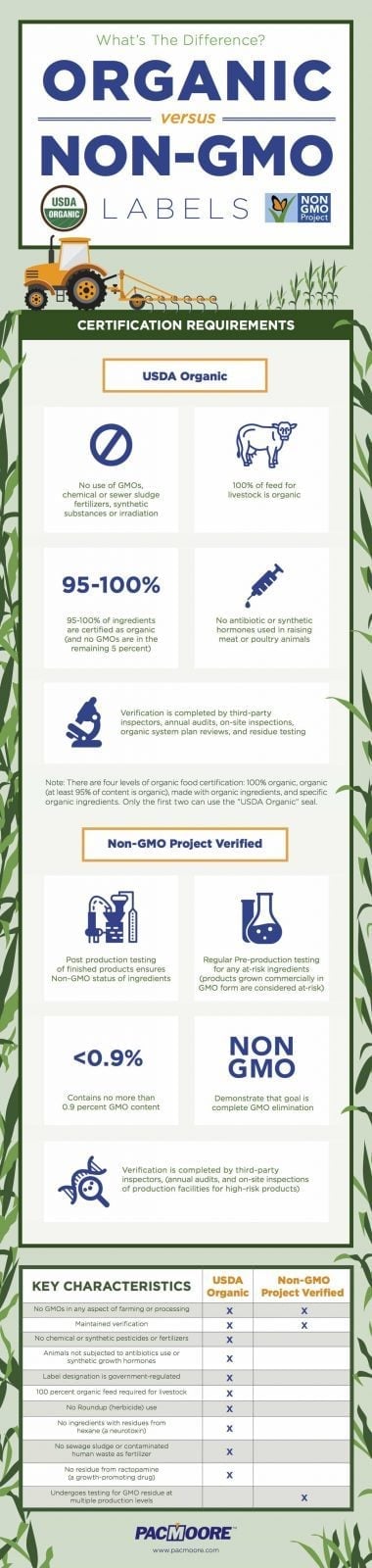
PacMoore recently released an interesting infographic on the differences between organic and non-GMO labels. Most consumers, as well as food brands, struggle to understand what is the difference. The certification and verification process is much different. Check out PacMoore’s infographic to learn more!

organic non-gmo what is difference certification verification

Inspired by https://www.pacmoore.com/organic-versus-non-gmo-labels/

https://nutrifusion.com/wp-content/uploads/2022/05/NutriFusion-Logo-New-1030x251.png 0 0 NF Admin https://nutrifusion.com/wp-content/uploads/2022/05/NutriFusion-Logo-New-1030x251.png NF Admin2018-03-07 08:46:382018-03-07 08:46:38Infographic: Organic vs. Non-GMO – What’s the Difference?

On-The-Go Habits Putting Pressure on Ingredient Manufacturers

in Beverages & Drinks, Consumer Packaged Goods, Food Business, Supplements & Nutraceuticals

Reading Time: 3 minutes

During the CAGNY conference in Florida, Food Dive sat down with ingredient manufacturer, Ingredion, to talk about insights into how CPG companies are planning for growth and adapting to changing consumer preferences. The CEO of Ingredion, Jim Zallie, believes that on-the-go consumption habits are the most challenging for the ingredient industry. The lucrative market opportunity is leading new players in the restaurant and retailer industry to compete with well-known CPG brands.

The Grab-and-Go is Stressing Ingredient Companies to Adapt

Jim Zallie told a consumer analyst group that the grab-and-go market, as well as food ordered online, has reached $110 billion globally. In just one year, from 2015 to 2016, the amount of U.S. on-the-go purchases grew by 56%. Zallie told the audience that this is critical to ingredient companies because of the importance of developing high-quality products that deliver the right texture and maintains heat.

Ingredion North American President, Jorgen Kokke says that texture claims on packaging have increased by over 90% in the past five years.

“We can talk about health trends… We can talk about cost and affordability and sustainability, but underneath all of that, [food] always has to taste good and be fun. And that’s where texture comes in. … We say it’s as important as flavor.”

Jorgen Kokke

Pockets of Growth in Functional On-The-Go Foods

Zallie believes there are “pockets of growth in the food anywhere space.” He points to the fresh refrigerated space as a critical example. The freshly prepared food category is generating over $25 billion in sales annually according to the Supermarket Guru. The clean label trend and simple ingredient trend play significant roles in the development of functional on-the-go foods. With 62% of consumers now looking for recognizable ingredients on the label, it’s imperative to use things they understand.

NutriFusion developed the GrandFusion product line for this very reason. We saw the way synthetic vitamins were reading on the label and thought there had to be a better way. With our products, consumers read fruits and vegetables instead of chemicals, so it makes a lot more sense to them. See the graphic below. If you are interested in learning more, visit our R&D page and download the GrandFusion resource kit to get started with product development.

supplements-ingredients-nutrition-panel-clean-label

https://nutrifusion.com/wp-content/uploads/2018/03/healthy-food-ingredients-P9LTHGD-min.jpg 1030 1486 NF Admin https://nutrifusion.com/wp-content/uploads/2022/05/NutriFusion-Logo-New-1030x251.png NF Admin2018-03-06 08:57:572018-03-06 08:57:57On-The-Go Habits Putting Pressure on Ingredient Manufacturers

New Survey Reveals Why Consumers Buy Plant-Based Dairy Alternatives

in Beverages & Drinks, Consumer Packaged Goods, Food Business, Food Retail, Supplements & Nutraceuticals

Reading Time: 2 minutes

Comax Flavors introduced survey last summer to better understand consumer perceptions around plant-based dairy alternatives. Comax surveyed 1,000 adults in the United States last July that said they used plant-based dairy products at least three days a week.

Why are Consumers Buying Plant-based Dairy Products?

This question about purchase behavior was at the center of Comax’s survey. They found that for most (48%) consumers, the flavor was the top reason why the purchased the plant-based alternatives. The most frustrating takeaway for the dairy industry was that 36% of consumers bought plant-based dairy products because of the perceived health benefits. Dairy industry veterans are annoyed because they believe that cow’s milk is nutritionally superior.


The survey also took a look at health and wellness as well as animal welfare to understand better why the rapid growth in plant-based dairy products. They found that the younger generations (millennials and Gen Z) were more concerned and influenced by animal welfare. As a result, they are purchasing more plant-based products all around.

The Plant-Based Category Continues to Soar, and Dairy Fights Back

Non-dairy milk sales have soared over 61% in the past five years to an estimated market size of $2.11 billion in 2017. In that same period, regular dairy milk sales have dropped by 15% to $16.12 billion in 2017.


The dairy industry is not going down without a fight and is pursuing a variety of options to challenge the new plant-based dairy alternatives. They are taking plant-based beverages to court over the word “milk” much like how Unilever challenged Just Mayo over the use of “Mayo” in the name. It will be interesting to see how this plays out.

The dairy industry is also trying to diversify with innovative products including carbonated or fizzy milk products. The new products have a longer shelf life than traditional milk which hits on one of the plant-based dairy’s competitive advantages.

Plant-based dairy products are not going anywhere anytime soon. It’s interesting to see why consumers are buying them and it turns out the flavor is the significant factor. The dairy industry will have their hands full trying to slow down this plant-based boom.

Inspired by www.fooddive.com

https://nutrifusion.com/wp-content/uploads/2022/05/NutriFusion-Logo-New-1030x251.png 0 0 NF Admin https://nutrifusion.com/wp-content/uploads/2022/05/NutriFusion-Logo-New-1030x251.png NF Admin2018-02-26 09:49:472018-02-26 09:49:47New Survey Reveals Why Consumers Buy Plant-Based Dairy Alternatives

Trends: Consumers Want More Functional, Healthy Beverages

in Beverages & Drinks, Food Business, Food Retail

Reading Time: 3 minutes

Consumers approach wellness in a holistic view these days. They prefer foods that come are organic and GMO-free, and other clean label cues. This trend is taking over drinks as well as more consumers want functional and healthy beverages.

The Trend for Healthy Beverages

Innova Market Insights, a Netherlands-based company, noted that many consumers are now becoming savvy when it comes to buying their favorite drinks. In 2016, a trend regarding the rising consumption of functional beverages rose to 27.2% from 12.6% in 2012. This means that more people opt for drinks that are fortified with vitamins and minerals or those that contain high amounts of protein for muscle buildup. These drinks are touted for their health benefits. The result is many companies in the US and UK are shifting their focus to healthy beverages to supply the growing demands of the market.

coco cocktail nutrifusion refresh alcoholic beverage

Aside from functional beverages, there is also a growing trend called “lighter enjoyment” where consumers are opting for alcoholic drinks that have lighter alcohol content and more flavor and texture to reap the benefits of the alcoholic beverage without the need to be intoxicated.

Today’s shoppers are taking health and other wellness-related matters into their own hands, and this has created a niche within the beverage industry to meet the growing demand. There is an increasing number of consumers who are following healthy routines such as training and exercising, so they need a drink to support their lifestyle.

The Effect of The Healthy Beverage Market

So why are many people turning to healthy foods and beverages instead of medicine? People who are not getting their desired results from traditional medicine are trying out health and wellness products. The trend here is an opportunity for companies to innovate their products into functional food and beverages.

This is where personalization of products comes in as people have different preferences when it comes to their health and wellness. For instance, people who follow specific diets tend to avoid specific ingredients in their beverages. So the traditional, one-size-fits-all approach to creating drinks is no longer a reliable concept for manufacturers.


Many shoppers are making more focused and informed buying decisions. They are very mindful of the types of products that they buy.  Aside from the kinds of ingredients, the “why,” as well as the “how” behind the product, is an essential factor in the decision making process of today’s shoppers. This adds another layer of complexity to the food and beverage industry to develop products that will appeal to more educated customers.

Beverages attribute to more than $11 billion in global sales, and these highly competitive functional drinks are slowly creeping up to make up a quarter of the market. In fact, functional and healthy beverages made $3.1 billion in sales last year, and the projections seem to grow more by the year.

Inspired by www.bevindustry.com

https://nutrifusion.com/wp-content/uploads/2017/02/green-and-red-fresh-juices-or-smoothies-PQAN7PY-min.jpg 1030 1545 NF Admin https://nutrifusion.com/wp-content/uploads/2022/05/NutriFusion-Logo-New-1030x251.png NF Admin2018-02-14 08:38:032018-02-14 08:38:03Trends: Consumers Want More Functional, Healthy Beverages

Daymon Report: Private Label Brands Are Booming

in Animal Nutrition, Beverages & Drinks, Consumer Packaged Goods, Food Business, Food Retail, Supplements & Nutraceuticals

Reading Time: 2 minutes

Daymon, global consumer retail, and private label brand agency, recently published its first Private Brand Intelligence Report. In the report, Daymon analyzes how retail brands and private label brands are competing based on proprietary survey data, category research, and expert insights.

Significant Findings in the Private Brand Daymon Report

Daymon’s analysis found some interesting insights for private label brands and some dangerous ones for national brands. The agency found that 81% of shoppers buy private label brands on every or almost every shopping trip. 85% of consumers in the study indicated that they trust store brands as much as their national counterparts. On top of these shopper stats, private label brand sales are up 4% over national brands in the past 12 months.

Daymon CEO, Jim Holbrook, believes that this is a “renaissance period” for store brands. He attributes this growth in private label to the way retailers are creating one-of-a-kind brands that national competitors are even having a time emulating. Grocery discounters like Aldi and Lidl are causing turmoil for traditional retailers because of their low cost, organic private label brands. The report concludes that the majority of shoppers (60%) want retailers to create more private brands in the fresh products category. Consumers can expect retailers to listen and start competing more aggressively in this category over the next 36 months.

Private Label is Disrupting Retail in a Big Way


The Private Label Manufacturer’s Association reports that store brands make up 17% of all grocery sales with a market size of $150 billion. Retailers like Aldi and Target have changed the way consumers think about private label. They now often recognize these store brands with quality and trust. National products are finding it tougher and tougher to compete with lower cost alternatives that are built on transparency and trust.

However, the private label market is facing some inside challenges. Brandless, San Francisco-based e-commerce startup, offers 115 “brandless” private label brands for the same price. For only $36, consumers can get free shipping all year on all orders.

As private label gets more competitive, it’s imperative for retailers to get savvy and compete even more. Simple ingredients and clean label products will be a win-win for store brands. Download our GrandFusion R&D Resource Kit to learn more about how our products can help you stand out from the crowd.

https://nutrifusion.com/wp-content/uploads/2019/07/shutterstock_145634968.jpg 1030 1545 NF Admin https://nutrifusion.com/wp-content/uploads/2022/05/NutriFusion-Logo-New-1030x251.png NF Admin2018-02-12 08:38:352018-02-12 08:38:35Daymon Report: Private Label Brands Are Booming

Personalized Diets: Can Your Genes Really Tell You What to Eat?

in Food Business, Health & Nutrition, Kid's Health

Reading Time: 3 minutes

The idea that our genes contain the blueprint for personalized nutrition is the driving force behind personalized nutrition testing. Websites and food companies are currently proliferating such as Nutrigenomix, Profile Precise, and Habit to name a few who provide these personalized services. But, is this true? Well, the answer is not straightforward. But, here are a few details on the idea behind genes and diets.

Personalized Testing Pairs Genes With Nutritional Needs

So, what is personalized testing for? In one article, a writer tried Habit. And the first step in the process is getting tested. You can do it yourself with the use of an at-home test kit for DNA and blood samples. Blood samples are taken twice. The first time is before drinking a high fat and sugary test drink and the second one is after taking the drink.

Then the samples are analyzed and based on the results you will be categorized into one of the seven diet types. Examples of which are range seeker, balance seeker, protein seeker, and fat seeker to name a few.

With the writer’s results, she was analyzed as a protein seeker which meant that her diet should consist more of high protein than any other food group. Other details are also included in the report, which would give you great insights into your personalized diet as well as further cementing your theories about your food response. As an example, the writer’s detailed report confirmed her thoughts on caffeine—that she has a gene variant that makes her sensitive to caffeinated food and drinks.

The high sugar drink acts as a fasting blood test, although it tests a person’s glucose response, it is not a test based on DNA. Further, the test also studies the FTO gene which is linked to weight gain in people who have this gene variant.


Systems Approach

Based on the example above, the personalized testing is not merely based on genes. It is a systems approach that is integrated together, and from there, each is given a customized recommendation.

The idea behind these personalized testing is that it gives people reliable evidence of what their body is currently experiencing. And these values can be instrumental in helping them to rein in their food urges and resist temptation—and maybe even embrace a healthy lifestyle.

Experts Take

Plenty of experts have pointed out that when it comes to pieces of advice on diets, it is quite deceiving to say that our genes are the blueprint because they are not. Although DNA does influence our weight, it is minimal. Our DNA cannot ever dictate to us when it comes to eating that piece of moist and delicious cake. It’s your behavior towards food that dictates which food you put into your body. According to studies, genes only account for five to ten percent of the risk connected with diseases related to diets like type-2 diabetes and obesity.

Inspired by www.npr.org/sections/thesalt

https://nutrifusion.com/wp-content/uploads/2018/02/vegetable-nutrition-facts-information-on-a-device-PMGEL77-min.jpg 1030 1543 NF Admin https://nutrifusion.com/wp-content/uploads/2022/05/NutriFusion-Logo-New-1030x251.png NF Admin2018-02-07 09:41:312018-02-07 09:41:31Personalized Diets: Can Your Genes Really Tell You What to Eat?

Top 7 Food & Beverage Industry Predictions for 2018

in Beverages & Drinks, Consumer Packaged Goods, Food Business, Food Retail

Reading Time: 4 minutes

What can we expect for the year 2018? What do you think the food and beverage industry will bring to our dining tables this year? You may have a lot of questions, but one thing is for sure, delicious and healthy improvements are in the forecast. Concentric, a leading marketing and branding agency, curated the top seven food and beverage industry predictions for 2018. Let’s take a look!

1 – Instagrammable Food Packaging

Is it “Instagrammable?” If it is, then most likely the food or beverage product will be shared by thousands, if not millions, of people on social media. Free and instant exposure—and this makes it a good selling point for manufacturers. Concentric expects to see an upsurge of carefully organized breakfast bowls that may be too appealing to destroy. And of course, brands would delve into the heightened aesthetics of their packaging.

2 – Light Snacking

Small, frequent feedings have been a slogan of a lot of diets which has led to the rise in snacking. Shoppers’ search for light snacks has been in full swing for the past few years. This year will be a bit different with food manufacturers rolling out “light” snacks and drinks, instead of the outdated and overpowering flavors. Food and drink producers are now geared for lighter tasting options like floral enhanced waters, less sweetness, less alcohol, and lighter ABVs as a whole.

3 – Exotic Flavors

More and more US consumers are embracing various ethnic flavors. As the American palate becomes more and more accustomed to International dishes, newer flavors are being introduced in the market. Think in the lines of za’atar, harissa, tahini, falafel, and pita to name a few.

4 – Plant-Based Still Going Strong

While this trend is nothing new, the innovation and technology behind this growth are evolving. The direction of going plant-based is growing by leaps and bounds with introductions like plant-based egg substitutes and veggie burgers. Also, think of foods in the lines of jackfruit and zoodle pasta dishes.

5 – Natural Processing


A lot of diets debuted in the past few years totally eliminated processed foods in the diet. So, this may not be new but naturally-processed foods will be a big hit in 2018. We are slowly evolving into the mindset of “less is more.” And this is the niche where smaller companies can explore and seize opportunities by being able to deliver naturally-processed, no-preservative, and higher quality food.

6 – Sustainability and Sourcing

We’ve heard a lot of phrases like farm-to-fork, farm-to-plate, sustainable sourcing, local sourcing, fair coursing, etc.—all these means sourcing and sustainability practices. The food industry is reducing their footprint while making food fresher longer and saving money. It is seen that the food industry is looking into kelp and seaweed for a more nutrient rich and sustainable food option.

7 – Transparency

This has been an age-old fight between consumers and producers, but it is seen that in 2018 food manufacturers are more than ever going to strive harder for brand and food transparency or else risk losing their market. 2018’s consumer is more probing and meticulous when it comes to their food than ever.

Final Thoughts on Predictions

2018 is going to be an important year for the food and beverage industry. Many of the new products and reformulations have been in the works over the past 18 months and their launches will be critical. Be on the lookout for products utilizing multiple trends mentioned above to attract consumers. A variety of products with GrandFusion launching in 2018 will pair plant-based and light snacking trends together. These superfood snacks will pack a nutritional punch from GrandFusion’s plant-based vitamins without impacting the flavor or texture. Interested in learning more? Download our GrandFusion R&D Resource Kit.

https://nutrifusion.com/wp-content/uploads/2016/04/at-the-grocery-store-PFKGTK8-min.jpg 1030 1460 NF Admin https://nutrifusion.com/wp-content/uploads/2022/05/NutriFusion-Logo-New-1030x251.png NF Admin2018-02-01 09:50:162018-02-01 09:50:16Top 7 Food & Beverage Industry Predictions for 2018
Page 22 of 41«‹2021222324›»

NUTRIFUSION®

GrandFusion® is a blend of fruits and/or vegetables that can significantly increase the nutritional profile and, therefore, the marketability of food, beverage, pet, and snack products.

Categories

  • Animal Nutrition
  • Beverages & Drinks
  • Consumer Packaged Goods
  • Corporate Partnerships
  • Corporate Updates
  • Featured
  • Food Business
  • Food Retail
  • GLP-1
  • Health & Nutrition
  • Infographics
  • Kid's Health
  • News
  • Press Releases
  • Product Announcements
  • Recipes
  • Supplements & Nutraceuticals
  • Uncategorized

ABOUT NUTRIFUSION®

NutriFusion® provides the nutrient-rich benefits of fruits and vegetables in everyday food products through whole non-GMO foods to create its concentrated micronutrient and phytonutrient-rich food ingredient blends.

Search NutriFusion

Search Search

SEAL OF AUTHENTICITY

NUTRIFUSION® CERTIFICATES

NutriFusion Cert Bar

Categories

  • Food
  • Beverages & Drinks
  • Pet Food
  • Nutraceuticals
  • Contact Us
  • Privacy Policy

© Copyright 2026 NutriFusion LLC | All Rights Reserved.

Scroll to top Scroll to top Scroll to top