
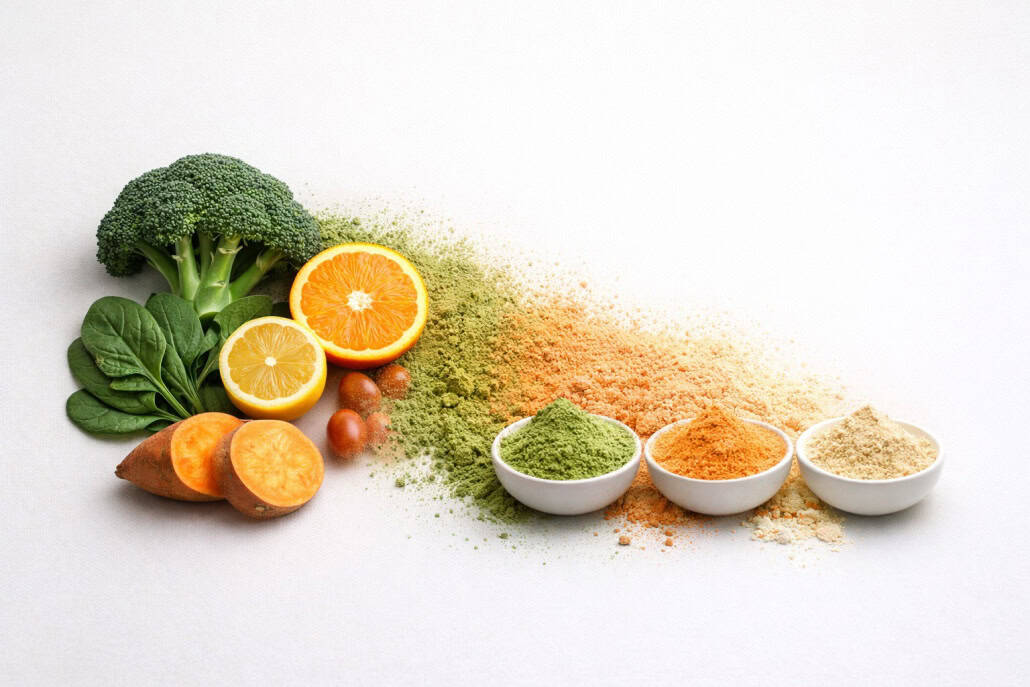
Why Vital Nutrients Are Better Delivered Through Whole Food Ingredients
Manufacturers face a persistent problem with fortification: synthetic vitamins look good on a label but often underdeliver in the body. As consumers grow more skeptical of artificial additives and regulatory scrutiny on nutrient claims tightens, the case for whole food ingredient systems is becoming harder to ignore. For formulators sourcing vital nutrients across food, beverage, supplement, or pet categories, the delivery mechanism matters as much as the nutrient itself.
How the Body Actually Absorbs Vital Nutrients
Not all forms of a vitamin are absorbed equally. Bioavailability describes how much of a nutrient reaches systemic circulation after ingestion. Bioabsorption describes how well cells take it up and use it. Synthetic vitamins, though chemically similar to their natural counterparts, are often stripped of the cofactors, phytonutrients, and fiber matrices that support absorption in whole food sources.
Research consistently shows that vital nutrients consumed within a whole food matrix tend to be better retained and utilized. Vitamin C from fruit and vegetable extracts, for instance, is accompanied by bioflavonoids and polyphenols that support uptake in ways that isolated ascorbic acid cannot fully replicate. The same logic applies across fat-soluble vitamins, B vitamins, and minerals, where co-occurring compounds influence how efficiently the body processes each nutrient.
For manufacturers building products around functional nutrition claims, this gap between label promise and actual delivery carries real commercial risk. A product fortified with poorly absorbed synthetic vitamins can undercut the very positioning it was designed to support.
Why Whole Food Matrices Perform Better in Formulation
Stability is a persistent concern at the formulation stage. Vital nutrients must survive processing conditions that include heat, pressure, pH exposure, and extended shelf life. Synthetic vitamins can degrade rapidly under these conditions, often requiring excess dosing or specialized protective coatings to compensate for loss.
Whole food-derived nutrient concentrates, when properly engineered, hold up under demanding applications. NutriFusion's GRAS Notice GRN 769, filed with the FDA, includes cooked pasta stability data showing that vitamin C percent Daily Value aligned with the declared label claim after processing. This is a concrete benchmark for what plant-based ingredient systems can achieve in real manufacturing environments.
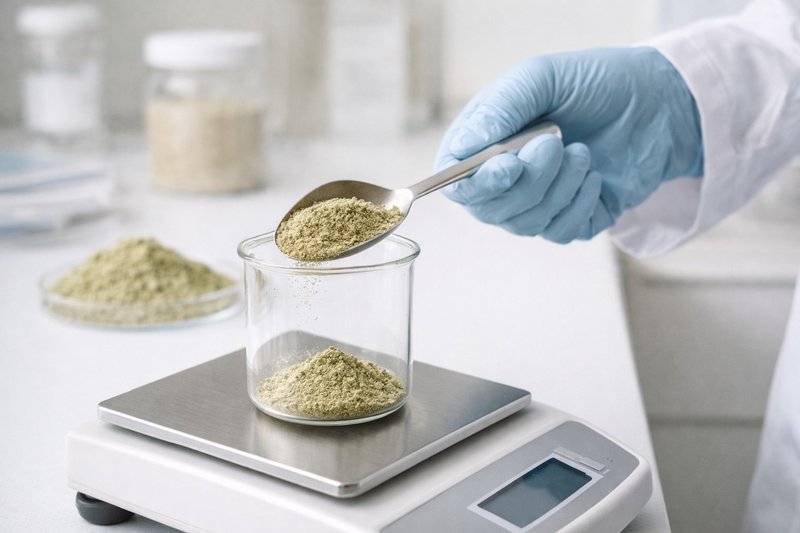
Key formulation advantages of whole food nutrient systems include:
- Ingredient statement clarity: Fruit and vegetable names replace synthetic chemical nomenclature, directly supporting clean-label strategy
- Reduced SKU complexity: Multiple vital nutrients consolidated into a single premix powder mean fewer purchase orders, less storage overhead, and simpler QA workflows
- Processing stability: Well-engineered blends can maintain Daily Value delivery through heat and shelf life without excess overages
- Sensory compatibility: Concentrated formats can be incorporated at low use rates without affecting taste or texture in the finished product
The Clean-Label Calculus for Brand Teams
Clean-label formulation is no longer a niche premium play. Across food, beverage, nutraceutical, and pet categories, brand teams face growing pressure to simplify ingredient lists, substantiate claims, and source ingredients that align with consumer expectations around transparency.
Synthetic fortification has historically been the default because it is cost-efficient and predictable. But that cost advantage narrows when brands factor in the overhead: overages to compensate for processing loss, label language that draws consumer skepticism, and sourcing complexity when managing multiple individual actives.
A single whole food blend that delivers vital nutrients at scale, such as NutriFusion's NF-82333 blend which achieves 100% Daily Value for 21 vitamins and minerals per 491 mg, collapses that complexity into one ingredient line and one purchase order.
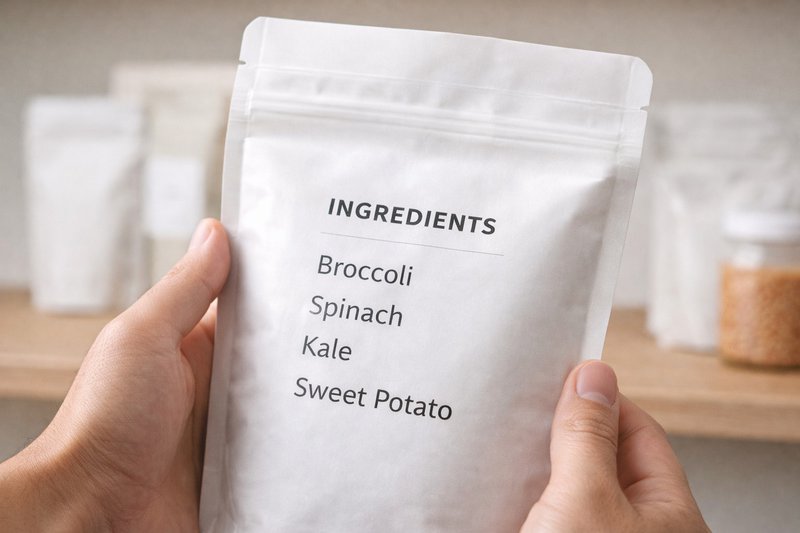
The ingredient statement itself becomes a differentiator. Broccoli, spinach, kale, and sweet potato read differently to a product development team and to a consumer than a column of synthetic vitamin names. That difference translates directly into claims, positioning, and the ability to support a premium that the market increasingly rewards.
How NutriFusion Delivers Vital Nutrients Through Whole Food
NutriFusion is built specifically for manufacturers who need whole food nutrition to perform inside a real product. Its proprietary GrandFusion blends are plant-based, bio-organic, bioavailable, and bioabsorbable, derived from whole food sources including fruits, vegetables, and mushrooms rather than synthetic vitamin systems.
The practical implications for formulators are direct:
- NutriFusion's 6-nutrient blends deliver 50% Daily Value per 225 mg across vitamins including Beta Carotene, C, D, E, B1, and B6, from ingredients like broccoli, spinach, orange, and maitake mushroom
- The 12-nutrient blend covers 12 vitamins at 50% Daily Value in the same 225 mg dose, offering a more comprehensive vital nutrient panel without adding use-rate complexity
- The 21 vitamin and mineral blend (NF-82333) reaches 100% Daily Value for 21 nutrients, including iron, iodine, zinc, and selenium, in under half a gram of powder
NutriFusion also offers minimum orders starting at one pound, making pilot formulation accessible for emerging brands without large upfront inventory commitments. Blends are Kosher, Halal, SQF, and cGMP certified, satisfying the documentation requirements that most brand legal and QA teams need before scaling.
NutriFusion's ingredients are also designed to hold their Daily Value claims through extrusion, baking, and extended shelf life. When your vital nutrient system performs through processing, the compliance story travels with the finished product rather than being engineered around it.
If your formulation team is evaluating whole food-based vital nutrient systems, NutriFusion offers blends that are built to perform from the ingredient spec through to the finished label claim. Start the conversation at: https://nutrifusion.com/
References
- U.S. Food and Drug Administration. 2017. "GRAS Notice GRN 690: Fruit and Vegetable Vitamin Extract." FDA. https://www.fda.gov/files/food/published/GRAS-Notice-GRN-690-Fruit-and-vegetable-vitamin-extract.pdf
- U.S. Food and Drug Administration. 2019. "GRAS Notice GRN 769: Fruit and Vegetable-Derived Vitamin C Extract." FDA. https://www.fda.gov/media/127844/download
- FoodNavigator-USA. 2024. "NutriFusion's Flexible Minimum Orders Resonate with Emerging Brands." William Reed. https://www.foodnavigator-usa.com/Article/2024/08/28/nutrifusion-s-flexible-minimum-orders-resonate-with-emerging-brands