• Link to LinkedIn
  • Link to Facebook
  • Call Us
NutriFusion
  • Applications
    • All Blends
    • Food
    • Beverages & Drinks
    • Nutraceuticals
    • Pet Nutrition
    • Custom Superfood
  • R&D
    • Research & Development
    • Vitamin Deficiency
  • Active Research
  • About
    • About NutriFusion®
    • Certifications
  • Contact
  • News
    • Press Center
  • Podcasts
  • Blog
  • Store
  • Click to open the search input field Click to open the search input field Search
  • Menu Menu

Archive for category: Supplements & Nutraceuticals

Watching The Moving Target On Consumer Preferences

in Beverages & Drinks, Consumer Packaged Goods, Food Business, Food Retail, Supplements & Nutraceuticals

For several years already,  consumer preferences have placed importance on their health and wellness. In the recent American Bankers’ Association annual convention, Todd Hale noted that while people want healthy foods, they also want to indulge. Fortunately, there is a growing trend of healthy indulgent categories. For instance, favorite comfort foods such as pies and other specialty desserts have experienced growth according to Nielsen data.

Retailers Take Advantage of the Desire for Freshness

There is an increasing desire for consumers to eat sweet goods that are fresh. Most consumers prefer fresher products, and this fact is used as an advantage by retailers. Food manufacturers use specialized packaging on cakes, cookies, and donuts. Moreover, they also place these products around the store so that consumers can easily access them and not just go to the center store anymore to get them. Another strategy that retailers do is to use technology such as television screens to showcase their indulgent offerings.

Retailers know that consumers who are not afraid to indulge are likely to gravitate towards eating healthy. Jones-Barber from Dawn’s Bakers Truth noted that with the changing trend of people wanting to eat healthily, it is the role of food manufacturers and retail companies to deliver products that are healthy and also satisfies the indulgence of consumers.

Today’s Consumer Preferences Driven by Transparency and Truth

Aside from eating healthy, consumers also demand transparency and truth. This is the reason why many food manufacturers including Kroger are now jumping on the bandwagon for organic brands that come with clean labels. Consumers are now opting for food products wherein they know what they are made from or where they come from.

To date, there is a multitude of food manufacturers that create products with clean labels. Health-conscious individuals are also leaning towards products with a clean label because they are deemed healthier as they don’t contain preservatives, additives, and synthetic color and flavor.

Health and Wellness is a Moving Target

While it is easy to say that food manufacturers should focus on creating healthy products, it is often considered by food manufacturers as a moving target. The thing is that the term “health and wellness” can mean different things to different consumers.

Food manufacturers still need to define what their consumers think about “health and wellness.” Consumer feedback is essential for food manufacturing and retailers to address the needs of their consumers. This is the reason why there are so many products like trans-fat-free, sugar-free, and other ingredients that make a particular product more appealing to health-conscious consumers.

The ever-changing preferences of consumers make food manufacturers adapt to the ever-changing needs thus creating a wave of food trends along the way and demanding innovation from food manufacturers. And because it is a moving target, it can move quickly to new challenges and trends are created now and then.

Inspired by www.foodbusinessnews.net
NutriFusion Fruit and Vegetable Powders Nutritional Claims FDA

https://nutrifusion.com/wp-content/uploads/2022/05/NutriFusion-Logo-New-1030x251.png 0 0 NF Admin https://nutrifusion.com/wp-content/uploads/2022/05/NutriFusion-Logo-New-1030x251.png NF Admin2018-06-12 08:39:312018-06-12 08:39:31Watching The Moving Target On Consumer Preferences

Consumers Going All In On Allergy Free Foods

in Beverages & Drinks, Consumer Packaged Goods, Food Retail, Health & Nutrition, Kid's Health, Supplements & Nutraceuticals

Reading Time: 3 minutes

Over the past 20 years, there has been an increase in the number of people who suffer from food allergies. The increasing number of individuals with food allergies is one of the top reasons why most people develop specialized diets with preference to clean eating and non-GMO foods.

With consumers suffering from food allergies, more people want access to allergy free foods. In the 2004 passage of the Food Allergen Labeling and Consumer Protection Act, all food manufacturers in the United States are required to label their products with ingredients that may contain top allergens such as dairy, soy, gluten, peanuts, eggs, tree nuts, fish, and shellfish. This is the reason why you will see these ingredients in the label list in plain language. Thus, if the product contains “soy lecithin,” it should still indicate “Soy” on the package.

Allergy Free Food is on the Rise

Katherine Allmandinger, manager of strategic insight for Nielsen’s health and wellness practice, noted that there is a growth of allergy free foods in the market today. About 46% of consumers say that the allergy free claims of food manufacturers influence their purchase decisions.

In fact, there are two types of consumers who buy allergy free products–the worriers and wonderers. While worriers have medical bases to avoid a particular kind of ingredient due to adverse reactions, this only reflects a low percentage of the actual consumers who want allergy-free foods.

It is essential to take note that average consumers are not necessarily looking for allergy-friendly foods because they suffer from specific allergic reactions. Instead, they look for these foods because they want to cut out on too much dairy or they want to jump in on the bandwagon of eating healthy.

How Food Manufacturers Make Allergy-Free Products

Before the popularity of allergy-free foods, people only ate naturally allergy-free food. For instance, Enjoy Life, a food company in the United States, has been making allergen-free products for over a decade. Their factories were some of the first to have no cross-contamination with other products.


On the other hand, other food manufacturers are developing products that use alternative yet non-allergen ingredients. For instance, snack company Quinn uses sorghum instead of other gluten-containing grains to create their products. They also tested other ancient grains to be able to develop allergy-free products for their customers.

Allergy-Free Foods are a Trendy Niche in the Market

As food allergies continue to rise all over the world, the allergy-free food trend will likely flourish as more and more people want food products that are healthier. In fact, there are many noticeable booths and shops that showcase allergen-free options. Moreover, many food manufacturers are innovating their products so that they are not only healthy but that they also pass the taste test.

Inspired by www.fooddive.com

https://nutrifusion.com/wp-content/uploads/2018/06/176767-1.jpg 433 785 NF Admin https://nutrifusion.com/wp-content/uploads/2022/05/NutriFusion-Logo-New-1030x251.png NF Admin2018-06-04 08:45:172018-06-04 08:45:17Consumers Going All In On Allergy Free Foods

Nielsen: Private Label Sales Grew 3X Faster Than National Brands

in Animal Nutrition, Beverages & Drinks, Consumer Packaged Goods, Food Business, Food Retail, Supplements & Nutraceuticals

Reading Time: 3 minutes

In a recent report released by Nielsen and cited by Food Navigator, private label sales surpassed the sales of national brands. Private labels are manufactured by one company under another company’s brand or private label. Also called OEM products, they can add margin to stores as well as provide more credibility to shoppers.

The Benefits of Private Labels

Whether it is a bottle of orange juice or a bottle of ketchup, today’s shoppers are comfortable with private labels, which they also called “generic” brands.  There are a lot of benefits to using private labels. Private skip the big brand name, so there is no added cost which allows vendors to add cost or value to their product in other areas to make it more reliable. It is also a solid strategy for retailers as it can reduce competition in different categories.

The Growth of Private Label Sales


The Nielsen report has shows that private labels have experienced a complete reversal regarding its growth, sales, and popularity. In fact, future projections indicate that there will be continued growth for such products and that the market share could hit 25.7% by 2027. This translates to an 8% growth rate over the next ten years.

The popularity of private labels has resulted in retailers like Lidl, Aldi, and Trader Joe’s to earn more revenue and build customer loyalty. In fact, such retail companies have emphasized these products in their online and brick and mortar stores with much success.

National Brands Vs. Private Labels

Big food manufacturers are watching this trend with alarm. And even the brands that remain strong and unsurpassed by private label products are still watching with keen eyes and ready to react. Most national brands are working on convincing shoppers that national brands have been tried and tested and worth the extra cost. But in reality, market experts noted that longtime legacy brands could get an extra boost especially if they continue to innovate and do not rest on their laurels.

While the private label brands are not yet posing too much threat to national brands, there is still a possibility that it can happen. If national brands cannot keep up with the private labels, the market scene in the United States will look more like in Europe where private label commands more loyalty from consumers.  In fact, in the UK, private labels hold 45% of the market share within the grocery sector. The reason why private labels are popular in Europe is that they provide more value for the money and that they offer more choices to shoppers.

Private labels will be huge in the following years. If private labels keep up with the changes as well as offer more value and choices to shoppers, they can ride the current trend for a long time to come.

Inspired by www.fooddive.com

https://nutrifusion.com/wp-content/uploads/2022/05/NutriFusion-Logo-New-1030x251.png 0 0 NF Admin https://nutrifusion.com/wp-content/uploads/2022/05/NutriFusion-Logo-New-1030x251.png NF Admin2018-05-22 08:12:462018-05-22 08:12:46Nielsen: Private Label Sales Grew 3X Faster Than National Brands

Consumers of All Generations Are Loving Plant-Based Foods

in Beverages & Drinks, Consumer Packaged Goods, Food Business, Food Retail, Health & Nutrition, Supplements & Nutraceuticals

Reading Time: 3 minutes

In a report released by survey company Datassentials, it revealed that many Americans are shifting towards plant-based foods because of the benefits to the body. In fact, most people are increasing their intake of fresh fruits and vegetables more than ever.

There are many reasons why consumers are shifting towards a new diet regimen, and the reasons vary across demographics. For instance, 44% of the Generation Z consumers change to plant-based foods as they enjoy the taste of fruits and vegetables while 21% of millennial consumers opt for plant-based products to show support to the local farmers.  It is essential to take note that while consuming plant-based products come with a lot of functional benefits, many consumers are uncertain about the role of plant-based foods. In fact, fewer can identify the attributes of the specific plant-based foods that they are consuming.

Big Companies Are Jumping on The Bandwagon

Having said this, consumers who opt for the plant-based diet usually count on seeds, nuts, legumes, and whole grains as part of their pantry staples. But aside from these food items, consumers also eat more fruits and vegetables.

The increasing consumption of fresh produce and plant-based products has resulted in sales growth for big companies. Around 30% of the consumers limiting their use of meat (flexitarians or pescatarians) or avoiding meat (vegan or vegetarians) have been attracted to the new plant-based meat alternatives in the market. Even big corporations have embraced this trend. Companies like Starbucks, for example, have released its line of nut milk-based beverages while TGI Fridays have stepped into the plant-based territory by using Beyond Meat’s meatless burger to create most of their plant-based dishes.

How Other Companies Can Leverage on The Trend of Plant-Based Foods

While big companies are joining the trend in releasing products made from plant-based ingredients, smaller enterprises are a bit skeptical. However, food manufacturers can leverage the trend and attract more consumers by incorporating global flavors to make their food more interesting. Using bold flavors and ethnic recipes can also attract consumers. On the other hand, avoiding alienating descriptions such as putting on the label “vegan” or “vegetarian” will also help promote the product.

In fact, 85% of consumers agree that plant-based foods are fulfilling and as delicious as animal protein-based products. But more than mimicking animal protein, consumers are also drawn to colorful produce thanks to the promotion of smoothies and fruit bowls on social media. The thing is that social media plays a critical role in promoting plant-based foods, especially among millennials.

With the increasing number of consumers opting for plant-based foods, it is no wonder why many companies are embracing this niche thus the sale is likely to increase in the years to follow. The only challenge here is to give further knowledge to consumers so that they will be encouraged to eat more plant-based foods not only for their health but also for the environment.

Inspired by www.smartbrief.com

https://nutrifusion.com/wp-content/uploads/2018/05/bowl-with-buckwheat-and-salad-of-chickpea-B6DRXLG-min.jpg 1030 1545 NF Admin https://nutrifusion.com/wp-content/uploads/2022/05/NutriFusion-Logo-New-1030x251.png NF Admin2018-05-16 08:06:292018-05-16 08:06:29Consumers of All Generations Are Loving Plant-Based Foods

Study: Consumers Favor the Term “Plant-Based” Over “Vegan”

in Consumer Packaged Goods, Food Business, Food Retail, Health & Nutrition, Supplements & Nutraceuticals

Reading Time: 3 minutes

The vegan movement is becoming popular as more people are trying to live healthy lives. Vegan food products do not contain any animal products (or by-products). In fact, around 800 companies worldwide have made vegan products and have partnered with organizations such as Vegan Action to market vegan food products.

But while veganism is considered a solid movement, another movement is coming to the forefront – the plant-based diet. While the two terms are often interchanged with one another, the latter has a broader definition ranging from excluding animal-based product to just adding more fresh produce to your diet.

Increasing Number of People Opting for the Plant-Based Diet

In a survey conducted by HealthFocus International, about 17% of consumers in the United States consume predominantly a plant-based diet while 60% say they are cutting back on meat-based products.  And those who are cutting back on meat reveal that they don’t plan to go back to their massive meat-eating habits and would want to make this flexitarian lifestyle permanent.

According to Steven Walton, General Manager of Research at HealthFocus International, the change in consumer preference with regards to consuming more produce is prevalent through a wide variety of demographics. This means that this diet is not only popular among millennials but even the baby boomers and generation Z. Industry leaders can benefit from this information, but they might be too distracted by the many words that have sprung up such as vegetarian, flexitarian, and vegan.

Vegan vs. Plant-Based in Consumer Minds

With this confusion, many consumers prefer a singular term when describing the diet. According to a California-based food consultant, Mattson, more than 80% of people surveyed indicated that they prefer the terms “plant-based” over “vegan” when describing a diet that avoids all types of animal products.

While the term “vegan” is often used, “plant-based” is more flexible and gives consumers the impression that the food tastes better and it more likened to whole foods. Mattson president, Barb Stuckey, noted that that the term “plant-based” is more positive and does not include deprivation or allegiance to a self-defining cause such as environmentalism or animal rights, which veganism is known for. By using the term “plant-based,” any conversation about plant-based food becomes neutral and does not incite any negative reactions from other people including ethical vegans.

Why are People Opting for a Plant-Based Diet?

There are many reasons why many people shift to the plant-based diet. Based on the survey, 3 out of 4 individuals noted that they would like to consume more plant-based foods for health reasons while others opt for this diet to lose weight or contribute something to the environment.

As more consumers are more welcoming to the term “plant-based,” food manufacturers have also caught up. Companies like Good Karma Food launched its non-dairy yogurt and sales have continued to increase 50% yearly. Other companies such as Beyond Meat introduced its plant-based chicken strips and burgers that vegan consumers have embraced with much gusto. Having said this, the popularity of the “plant-based” term has resulted in a new and ever-growing niche.

Inspired by www.fooddive.com

https://nutrifusion.com/wp-content/uploads/2016/11/composition-of-fruits-and-vegetables-in-rainbow-82DUL49-min.webp 1030 1545 NF Admin https://nutrifusion.com/wp-content/uploads/2022/05/NutriFusion-Logo-New-1030x251.png NF Admin2018-05-08 10:40:332018-05-08 10:40:33Study: Consumers Favor the Term “Plant-Based” Over “Vegan”

Study Warns Brands to Rethink Clean Label Products

in Beverages & Drinks, Consumer Packaged Goods, Food Business, Food Retail, Supplements & Nutraceuticals

Reading Time: 3 minutes

Clean label products are are the fastest growing market in the food and beverage industry. While this movement is trending, it leaves a lot of gray areas—not only for the food manufacturers but also for the retailers and consumers. Unfortunately, there is no single definition of the word “clean label” even if it has been around for a few years. This has led to a lot of confusion among many people.

A joint study from the Food Marketing Institute and Solutions for Retail Brands called “The Clean Label Phenomenon for Food Retailers: Enhancing Transparency for consumers” is aimed at determining what consumers think about clean labels.

The Definition of Clean Label

So, what are clean label products? The conventional definition indicates that products are made from natural ingredients devoid of artificial additives, preservatives, and flavoring. Other definitions also include food that comes with ultimate authenticity as well as trustworthiness. The thing is that clean label is often interchanged with the word “natural” that is way too far from the truth.  Currently, there is no legal definition of a clean label, and the lack of a precise definition and consistency makes it confusing for everyone.

If you are a follower of the clean label movement, it is crucial to know which foods come with clean labels and which ones do not. While it is apparent among consumers that preservative and additives are not included in the clean label food list, 65% of shoppers are still confused such that they tend to avoid ingredients like sugar and salt actively. People consider GMO foods not to be clean label products.

Problems Involving the Clean Label Movement

Aside from the vague definition of “clean label,” another issue involving this movement is transparency. While consumers want more straightforward ingredient lists, what they want more is greater transparency. Further, different generations of consumers also demand different qualities from clean label products. The differing needs from each generation of consumers also mean that they have differing views on different brand labels. For instance, consumers that prefer free-from-modifications products may view other traditional unaltered products unacceptable.

While there are some problems involved in the clean label movement, food manufacturers and retailers can address these issues by being transparent when it comes to how they interpret the word “clean label.” For some companies, they may view clean labels as non-GMO ingredients while some might focus on how the ingredients are processed.

How to Solve the Problems with Clean Label Products

In fact, European companies are more receptive towards the clean label movement. The food industry in the United States can learn from European companies. To date, only 27% of packaged foods are marketed with a clean label to which private brands make up the most substantial amount of sales. While the sales of products that are packaged as a clean label are still meager in the United States, it will eventually grow as more and more people become more aware and conscious of the foods that they are eating. Hopefully, in the future, clean label products will be better defined so we can all get behind eating better for you foods.

Inspired by www.fooddive.com

https://nutrifusion.com/wp-content/uploads/2022/05/NutriFusion-Logo-New-1030x251.png 0 0 NF Admin https://nutrifusion.com/wp-content/uploads/2022/05/NutriFusion-Logo-New-1030x251.png NF Admin2018-04-27 08:43:052018-04-27 08:43:05Study Warns Brands to Rethink Clean Label Products

Vitamin Pills and Supplements Not Helping Most People

in Health & Nutrition, Supplements & Nutraceuticals

Reading Time: 4 minutes

Many people are willing to pop vitamin pills and supplements since they expect them to provide the body with essential vitamins and minerals that the body needs to function correctly. In fact, an article published in the journal JAMA noted that 52% of Americans reported that they take in at least one (1) dietary supplement a day.

While there are so many dietary supplements sold in the market these days, is taking supplements effective? Dr. JoAnn E. Manson, chief of preventive medicine at Brigham and Women’s Hospital, seems to think otherwise.

The popularity of supplements is part of the marketing ploy for many companies. Many detractors of vitamin pills and supplements believe that the best way to get the necessary micronutrients into the body is by eating the right kinds of food. A healthy diet is the best way for the body to absorb and get a wide array of nutrients into the body. Below are the few key things that you need to know when it comes to the consumption of synthetic vitamins and supplements.

Don’t Pop Pills, Eat Healthy!

A well-balanced diet is a great way to get essential micronutrients from food. Make sure that your diet is comprised of whole grains, fruits, vegetables, lean meats, seafood, nuts, and seeds. Not only will you get micronutrients but also fiber, antioxidants, and many other benefits. Make sure that you avoid foods that are highly processed as they are stripped of essential vitamins, minerals, and fiber.

You Can Overdose on Supplements

Many people believe that taking high doses of supplements such as folic acid, beta-carotene, and Vitamin E is beneficial to the body. However, clinical trials have noted that overdosing on supplements can have harmful side effects such as a stroke. Our bodies are not entirely sure what to do with a synthetic form of a nutrient and can sometimes react to high dosage.

Supplements Do Not Boost Immunity

If you believe that taking supplements can boost your immune system, then think again. So, if you have been popping Vitamin C supplements to ward off the flu, realize your magic supplement will not reduce the risk of developing flu or cold. However, there are some pieces of evidence that Vitamin C can shorten the symptoms of flu but only when taken in as food instead of supplements.

The Importance of Vitamin D

There is a lot of buzz going on about Vitamin D supplements and how it is vital to driving other processes in the body. While, studies have indicated that Vitamin D can reduce the risk for developing cancer, stroke, and heart disease, the consumption of pill supplements is not necessary as you can get 600-800 IU of Vitamin D daily by sunbathing early in the morning. Other natural sources include mushrooms and milk.

Take Supplements If Directly Recommended by a Doctor

While taking vitamins is not recommended for the general population especially those who are usually of good health, those who are in particular life stages or at high risk of developing diseases should consume supplements only if they are required by their physicians. For instance, people who suffer from osteoporosis can benefit from taking 1,000 IUs of Vitamin D but not too much as it can be linked to kidney stones especially if you are taking in calcium.

The conclusion here is to be careful about what supplements you are putting into your body. The best way to get the essential micronutrients you need is to consume them in whole foods. NutriFusion has figured out a way to help supplements companies create better products with whole food vitamins. Our powders concentrate the natural vitamins from fruits and vegetables into a blend that can be easily added to any product. Interested in learning more? Vist our supplements page.

Inspired by www.today.com

https://nutrifusion.com/wp-content/uploads/2022/05/NutriFusion-Logo-New-1030x251.png 0 0 NF Admin https://nutrifusion.com/wp-content/uploads/2022/05/NutriFusion-Logo-New-1030x251.png NF Admin2018-03-13 10:33:062018-03-13 10:33:06Vitamin Pills and Supplements Not Helping Most People

Infographic: Organic vs. Non-GMO – What’s the Difference?

in Beverages & Drinks, Consumer Packaged Goods, Food Business, Food Retail, Infographics, Supplements & Nutraceuticals

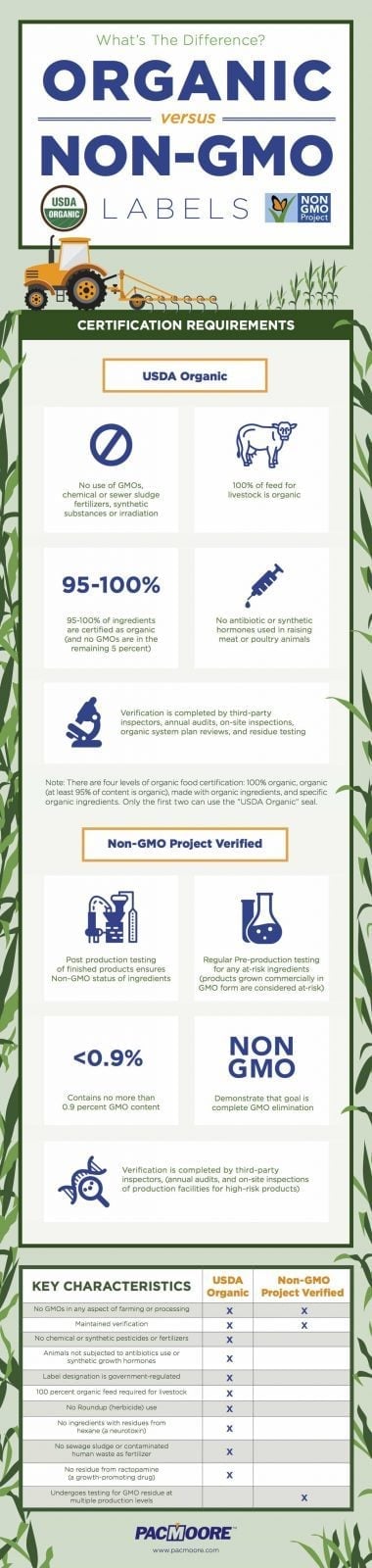
PacMoore recently released an interesting infographic on the differences between organic and non-GMO labels. Most consumers, as well as food brands, struggle to understand what is the difference. The certification and verification process is much different. Check out PacMoore’s infographic to learn more!

organic non-gmo what is difference certification verification

Inspired by https://www.pacmoore.com/organic-versus-non-gmo-labels/

https://nutrifusion.com/wp-content/uploads/2022/05/NutriFusion-Logo-New-1030x251.png 0 0 NF Admin https://nutrifusion.com/wp-content/uploads/2022/05/NutriFusion-Logo-New-1030x251.png NF Admin2018-03-07 08:46:382018-03-07 08:46:38Infographic: Organic vs. Non-GMO – What’s the Difference?
Page 9 of 17«‹7891011›»

NUTRIFUSION®

GrandFusion® is a blend of fruits and/or vegetables that can significantly increase the nutritional profile and, therefore, the marketability of food, beverage, pet, and snack products.

Categories

  • Animal Nutrition
  • Beverages & Drinks
  • Consumer Packaged Goods
  • Corporate Partnerships
  • Corporate Updates
  • Featured
  • Food Business
  • Food Retail
  • GLP-1
  • Health & Nutrition
  • Infographics
  • Kid's Health
  • News
  • Press Releases
  • Product Announcements
  • Recipes
  • Supplements & Nutraceuticals
  • Uncategorized

ABOUT NUTRIFUSION®

NutriFusion® provides the nutrient-rich benefits of fruits and vegetables in everyday food products through whole non-GMO foods to create its concentrated micronutrient and phytonutrient-rich food ingredient blends.

Search NutriFusion

Search Search

SEAL OF AUTHENTICITY

NUTRIFUSION® CERTIFICATES

NutriFusion Cert Bar

Categories

  • Food
  • Beverages & Drinks
  • Pet Food
  • Nutraceuticals
  • Contact Us
  • Privacy Policy

© Copyright 2026 NutriFusion LLC | All Rights Reserved.

Scroll to top Scroll to top Scroll to top